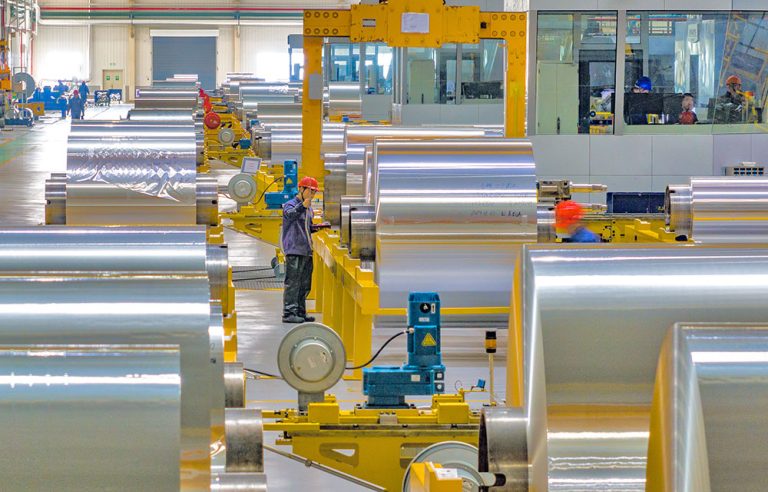
Cold Rolling Mills
Ⅰ,What is Cold Rolling?
Cold rolling is generally defined as a rolling process conducted at temperatures below the material’s recrystallization temperature.
Compared to hot rolling, although the temperature rises due to heat generated by plastic deformation during cold rolling, it does not exceed the recovery temperature. Consequently, the material exhibits high resistance to deformation and is prone to work hardening, which limits both the reduction per pass and the total reduction. However, the resulting products possess superior density, dimensional accuracy, surface quality, and flatness; cold rolling enables the production of thin strips and foils that cannot be manufactured via hot rolling. By varying reduction rates or employing post-processing heat treatments, products with diverse properties can be obtained to meet specific application requirements. Cold rolling operates at high speeds, reaching 600–800 meters per minute.
Ⅱ,Functional Configuration and Characteristics of Modern Cold Rolling Mills
To ensure the efficient production of high-precision strip materials, modern cold rolling mills feature increasingly comprehensive functional configurations, including:
- Automatic strip centering: Prevents strip deviation that could compromise flatness.
- Automatic roll gap adjustment: Enables control strategies such as constant roll gap or mass flow to achieve automatic gauge control (AGC).
- Automatic roll profile adjustment: Ensures the flatness and straightness of the finished strip.
- Automatic tension control: Establishes tension rolling to prevent strip breakage and deviation.
- Automatic speed control: Allows for stepless speed regulation and precise stopping.
- Automated handling functions: Includes automatic coiling, uncoiling, head straightening, shearing, coil loading, strapping, coil unloading, and automatic coil weighing to minimize auxiliary processing time.
- Automatic cooling and lubrication control: Enables zonal roll cooling to regulate strip flatness.
- Lubricant extraction/wiping: Minimizes residual oil on the product surface.
- Automatic multi-stage lubricant filtration: Ensures the cleanliness of the lubricant.
- Rapid roll changing: Reduces downtime associated with roll changes.
- Automatic fire suppression: Prevents fires in mills utilizing straight-oil lubrication systems.