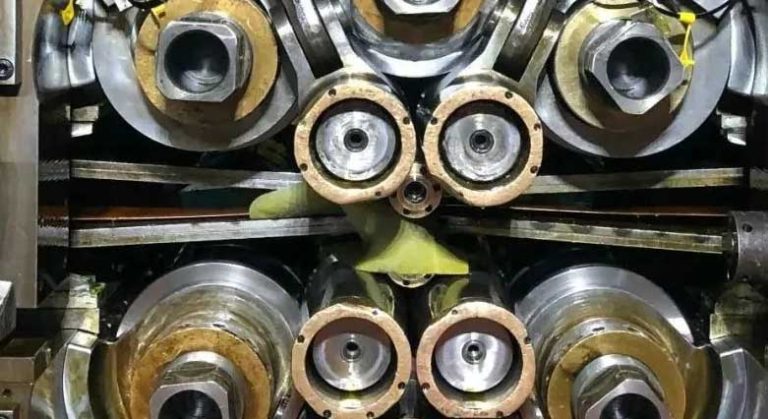
Equipment Structure and Performance Characteristics of 4 Hi Cold Rolling Mill
The 4 hi cold rolling mill represents one of the most significant advancements in metal processing technology, combining sophisticated engineering with practical functionality. This comprehensive guide explores the intricate equipment structure and remarkable performance characteristics that make these mills indispensable in modern steel and non-ferrous metal production facilities worldwide.
Introduction to 4 Hi Cold Rolling Mill Technology
The 4 hi cold rolling mill has established itself as a cornerstone technology in the metal processing industry, particularly for producing high-quality sheet and strip products. Unlike hot rolling processes that operate at elevated temperatures, cold rolling occurs at or near room temperature, resulting in superior surface finish, tighter dimensional tolerances, and enhanced mechanical properties through work hardening.
The designation “4 hi” refers to the four-roll configuration that distinguishes this mill type from simpler two-high mills or more complex cluster mills. This arrangement consists of two smaller diameter work rolls that directly contact the material being processed, supported by two larger diameter backup rolls that provide the necessary rigidity and force distribution. This configuration represents an optimal balance between rolling capability, equipment complexity, and operational flexibility.
Historical Development
The four-high mill configuration was developed in the early 20th century as engineers sought ways to produce thinner gauge materials with better surface quality. The breakthrough came with the realization that smaller work rolls could achieve greater reduction ratios while larger backup rolls could provide the structural support needed to prevent excessive deflection. Today’s 4 hi cold rolling mills incorporate decades of refinement, featuring advanced hydraulic systems, sophisticated automation, and precision measurement technologies.
Detailed Equipment Structure Analysis
Mill Housing and Frame Assembly
The mill housing serves as the structural foundation of the entire 4 hi cold rolling mill system. Constructed from high-strength cast steel or fabricated steel plate, the housing must withstand enormous rolling forces that can exceed 20,000 kN in large-scale operations. Modern housings typically feature a closed-top design that provides superior rigidity compared to open-frame configurations.
The housing incorporates precision-machined windows that guide the roll chocks, ensuring accurate roll positioning throughout the rolling process. Window liners made from wear-resistant materials protect the housing from damage and can be replaced when worn. The housing also includes mounting provisions for hydraulic cylinders, measurement systems, and auxiliary equipment.
Housing Material Specifications
- Cast steel grade: G20Mn5 or equivalent
- Tensile strength: ≥500 MPa
- Yield strength: ≥300 MPa
- Impact toughness: ≥27 J at -20°C
Design Considerations
- Finite element analysis optimization
- Stress concentration minimization
- Thermal expansion compensation
- Vibration damping characteristics
Roll Chock and Bearing Assembly
Roll chocks house the bearings that support the work rolls and backup rolls, representing critical components in the 4 hi cold rolling mill system. The chock design must accommodate the substantial loads transmitted through the rolls while allowing for precise positioning and rapid roll changes. Modern chocks utilize four-row tapered roller bearings or cylindrical roller bearings capable of handling both radial and axial loads.
Work roll chocks in contemporary mills often incorporate bending blocks that interface with the hydraulic roll bending system. These blocks transmit bending forces to the work roll necks, enabling real-time adjustment of roll deflection to optimize strip flatness. The chock-to-housing interface includes hydraulic clamping mechanisms that secure the chocks during rolling while permitting controlled movement for gap adjustment.
Screw-Down and Hydraulic Gap Control System
The gap control system in a 4 hi cold rolling mill determines the final thickness of the rolled product and represents one of the most technologically advanced subsystems. Modern mills employ hydraulic automatic gauge control (HAGC) systems that can adjust roll gap within milliseconds, responding to variations in incoming material thickness, hardness, and rolling conditions.
The hydraulic cylinders used in HAGC systems typically feature servo valve control with position feedback from linear transducers. Response times of 10-20 milliseconds are common, with positioning accuracy better than ±5 micrometers. The system continuously monitors strip thickness using X-ray or isotope gauges positioned at the mill exit, feeding this information to the control system for real-time adjustment.
Roll System Configuration and Specifications
Work Roll Characteristics
Work rolls in a 4 hi cold rolling mill directly contact the strip material and therefore require exceptional surface hardness, wear resistance, and thermal stability. The work roll diameter is carefully selected based on the intended product range, with smaller diameters enabling greater thickness reduction per pass but requiring more frequent replacement due to accelerated wear.
High-chromium steel and high-speed steel are the predominant work roll materials, with surface hardness typically ranging from 60-68 HRC. The roll surface undergoes precision grinding to achieve roughness values (Ra) between 0.2-1.6 micrometers depending on the product requirements. For bright annealing applications, mirror-finish rolls with Ra values below 0.1 micrometers may be specified.
Backup Roll Specifications
Backup rolls in the 4 hi cold rolling mill configuration serve the crucial function of supporting the work rolls against the enormous separating forces generated during rolling. These rolls are significantly larger in diameter than the work rolls, typically by a factor of 2-3, providing the necessary stiffness to minimize deflection across the roll face width.
The backup roll material is typically forged alloy steel with a hardened surface layer achieved through induction hardening or case hardening processes. Surface hardness values of 45-55 HRC are common, with the softer core providing toughness and resistance to catastrophic failure. The roll crown profile is carefully designed to compensate for thermal expansion and elastic deflection under load.
Performance Characteristics and Capabilities
Thickness Reduction Capability
One of the primary advantages of the 4 hi cold rolling mill configuration is its ability to achieve substantial thickness reductions while maintaining excellent product quality. The smaller work roll diameter, supported by the larger backup rolls, enables higher contact pressures and greater deformation per pass compared to two-high mills of equivalent rolling force capacity.
Typical single-pass reductions in a 4 hi cold rolling mill range from 20-45% depending on the material being processed, initial thickness, and desired final gauge. For carbon steel strip, total reductions of 70-90% are commonly achieved through multiple passes, transforming hot-rolled coils of 2-4 mm thickness into cold-rolled products as thin as 0.15 mm.
Key Performance Metrics
Surface Quality Achievement
The 4 hi cold rolling mill excels in producing strip with superior surface quality, a critical requirement for applications in automotive body panels, appliance housings, and packaging materials. The controlled deformation conditions, combined with effective lubrication and cooling systems, minimize surface defects such as scratches, roll marks, and heat streaks.
Surface roughness of the finished product can be precisely controlled through selection of appropriate work roll surface finish and rolling parameters. For applications requiring a bright, reflective surface, roughness values below 0.3 μm Ra are achievable. Conversely, for products requiring paint adhesion or subsequent forming operations, controlled roughness in the range of 0.8-1.5 μm Ra may be specified.
Flatness Control Systems
Achieving excellent strip flatness is one of the most challenging aspects of cold rolling, and modern 4 hi cold rolling mills incorporate sophisticated systems to address this requirement. Roll bending, both positive and negative, allows real-time adjustment of the work roll deflection profile to compensate for variations in strip width, thickness, and material properties.
Work roll bending forces in modern mills can reach ±1500 kN per chock, providing substantial capability to modify the roll gap profile. Additionally, many mills incorporate roll shifting systems that allow axial movement of rolls with specially designed crown profiles (CVC – Continuously Variable Crown), further expanding the flatness control envelope.
Flatness Control Methods in 4 Hi Cold Rolling Mills
- Work Roll Bending: Hydraulic cylinders apply forces to work roll chocks, modifying roll deflection
- Roll Shifting (CVC): Axial movement of specially crowned rolls changes effective roll gap profile
- Roll Cooling: Selective cooling across roll face controls thermal crown development
- Backup Roll Crown: Ground-in crown profile compensates for predicted deflection
- Roll Tilting: Differential adjustment of roll gap at operator and drive sides
Technical Specifications and Parameters
The following comprehensive specifications represent typical parameters for 4 hi cold rolling mills across different capacity ranges. These values serve as reference points for equipment selection and process planning, though actual specifications vary based on manufacturer design and specific application requirements.
Drive System Configuration
The drive system of a 4 hi cold rolling mill must deliver substantial torque while maintaining precise speed control across a wide operating range. Modern mills predominantly use AC variable frequency drives with vector control, providing excellent dynamic response and energy efficiency. The drive configuration may be either twin-drive (separate motors for each work roll) or single-drive with a pinion stand distributing power to both rolls.
Industrial Applications
The versatility of the 4 hi cold rolling mill makes it suitable for processing a wide range of materials across numerous industrial sectors. The ability to produce thin gauge material with excellent surface quality and tight dimensional tolerances has established these mills as essential equipment in modern manufacturing supply chains.
Automotive Industry
Body panels, structural components, and exposed trim parts requiring excellent formability and surface appearance. Typical gauges: 0.6-2.0 mm.
Appliance Manufacturing
Refrigerator panels, washing machine drums, and oven components. Requires consistent surface quality for enamel coating. Gauges: 0.4-1.2 mm.
Construction Materials
Roofing sheets, wall cladding, and structural decking. Cold-rolled base material for galvanizing and color coating lines. Gauges: 0.3-1.0 mm.
Packaging Industry
Tinplate for food cans, beverage containers, and aerosol cans. Extremely tight thickness tolerances required. Gauges: 0.15-0.35 mm.
Electrical Steel
Transformer cores and motor laminations. Requires precise thickness control for optimal magnetic properties. Gauges: 0.23-0.50 mm.
General Engineering
Precision strip for springs, fasteners, and stamped components. Wide range of steel grades and non-ferrous materials. Gauges: 0.2-3.0 mm.
Comparison with Other Mill Types
Understanding how the 4 hi cold rolling mill compares with alternative configurations helps in selecting the optimal equipment for specific applications. Each mill type offers distinct advantages and limitations that must be considered in the context of product requirements, production volume, and capital investment constraints.
The 4 hi cold rolling mill occupies a sweet spot in terms of capability versus complexity, making it the most widely deployed configuration for general-purpose cold rolling of carbon steel, stainless steel, and non-ferrous metals. While six-high and cluster mills offer superior performance for thin gauge and hard materials, the four-high configuration provides adequate capability for the majority of commercial products at lower capital and operating costs.
Maintenance and Operational Considerations
Preventive Maintenance Schedule
Maintaining optimal performance of a 4 hi cold rolling mill requires a comprehensive preventive maintenance program. The high forces and speeds involved in cold rolling operations place significant demands on all mechanical and hydraulic components, making regular inspection and servicing essential for reliable operation and product quality.
Roll Management Best Practices
Effective roll management is crucial for maintaining product quality and minimizing operating costs in 4 hi cold rolling mill operations. Work rolls typically require regrinding after processing 500-2000 tons of material, depending on the product mix and surface quality requirements. A well-organized roll shop with adequate grinding capacity ensures that fresh rolls are always available for scheduled changes.
Roll Shop Requirements
- Grinding Machines: CNC roll grinders with automatic crown grinding capability
- Measurement Equipment: Laser-based profile measurement systems for quality verification
- Storage Facilities: Climate-controlled storage to prevent corrosion and thermal distortion
- Handling Equipment: Overhead cranes and roll transporters rated for maximum roll weight
- Inventory Management: Tracking system for roll history, grinding records, and campaign performance
Lubrication and Cooling Systems
The lubrication and cooling system in a 4 hi cold rolling mill serves multiple critical functions: reducing friction between the rolls and strip, removing heat generated during deformation, and providing a protective film that prevents surface damage. Modern mills use sophisticated emulsion systems that deliver precisely controlled mixtures of oil and water to the roll bite and roll surfaces.
Typical emulsion concentrations range from 2-5% oil in water, with the exact formulation selected based on the material being rolled and the desired surface finish. The emulsion system includes filtration equipment to remove metal fines and other contaminants, heat exchangers to maintain optimal temperature, and monitoring systems to track concentration and condition.
Summary: The Value Proposition of 4 Hi Cold Rolling Mills
The 4 hi cold rolling mill continues to represent the optimal solution for a wide range of cold rolling applications, balancing capability, flexibility, and economic efficiency. Its four-roll configuration enables production of thin gauge materials with excellent surface quality and dimensional accuracy, while maintaining manageable complexity and operating costs.
Key advantages include the ability to achieve substantial thickness reductions per pass, excellent flatness control through work roll bending systems, and adaptability to diverse product requirements. Whether configured as a single-stand reversing mill for flexible production or as part of a high-speed tandem line for mass production, the 4 hi cold rolling mill remains an indispensable tool in modern metal processing operations.
Key Takeaways for Production Planning
Select work roll diameter based on minimum gauge requirements and available rolling force
Implement comprehensive roll management to maintain consistent product quality
Utilize advanced flatness control systems for demanding applications
Maintain lubrication systems to optimize surface quality and roll life