
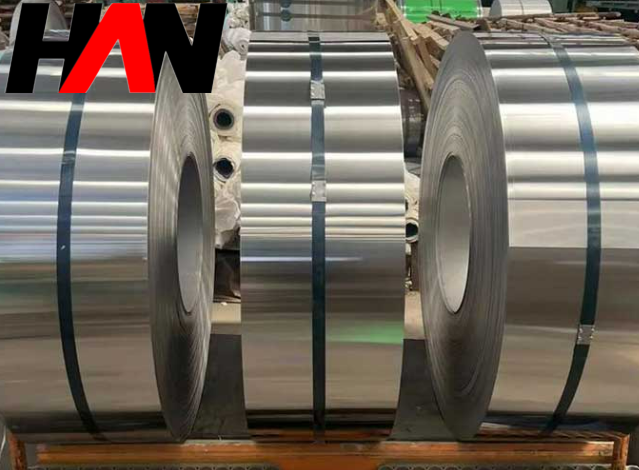
Cold Rolling Process
Cold rolling is a precision forming process in which hot-rolled stock is further rolled and thinned at room temperature; it serves as a core stage in the production of copper sheet and strip. Cold rolling not only enables precise control over product thickness but also significantly enhances dimensional accuracy, surface finish, strength, and flatness.
High-performance equipment—such as four-high reversing mills, six-high cold rolling mills, or twenty-high Sendzimir mills—is typically employed for cold rolling. Six-high and multi-roll mills are particularly well-suited for producing thin-gauge, high-precision copper strip due to their superior roll-system rigidity and strip-shape control capabilities. The reduction per pass must be appropriately set based on the material’s plasticity; owing to its excellent ductility, pure copper can withstand a single-pass reduction of 15% to 40%. Through multiple rolling passes, the total reduction can exceed 90%, allowing the copper sheet or strip to reach the target thickness.
The cold rolling process is accompanied by significant work hardening, which increases the material’s strength and hardness while reducing its plasticity and toughness. Once work hardening accumulates to a certain level, the material can no longer undergo further plastic deformation. Consequently, intermediate annealing treatments must be interspersed between rolling passes. Intermediate annealing is typically conducted at temperatures ranging from 400°C to 600°C with a holding time of 1 to 3 hours; the objective is to eliminate work hardening through recrystallization and restore the material’s plasticity, thereby facilitating further rolling.
For precision copper strip destined for high-end applications such as the electronics industry, finish rolling and temper rolling (or skin passing) are often required after the strip has been cold-rolled to its target thickness. Finish rolling utilizes a very small reduction (1%–5%), primarily to precisely control thickness tolerances (achieving up to ±0.001 mm) and improve strip shape. Temper rolling involves lightly rolling the strip surface with smooth rolls; the goal is not significant thinning, but rather the further reduction of surface roughness (achieving Ra ≤ 0.1 μm) to produce a mirror-like finish.
