Continuous Casting of Copper
Continuous casting is a truly uninterrupted production process in which the ingot length is theoretically infinite.
(1) Process Principle: Molten metal is continuously poured into a crystallizer (mold); the solidified ingot is continuously withdrawn and cut to length in-line.
(2) Common Types:
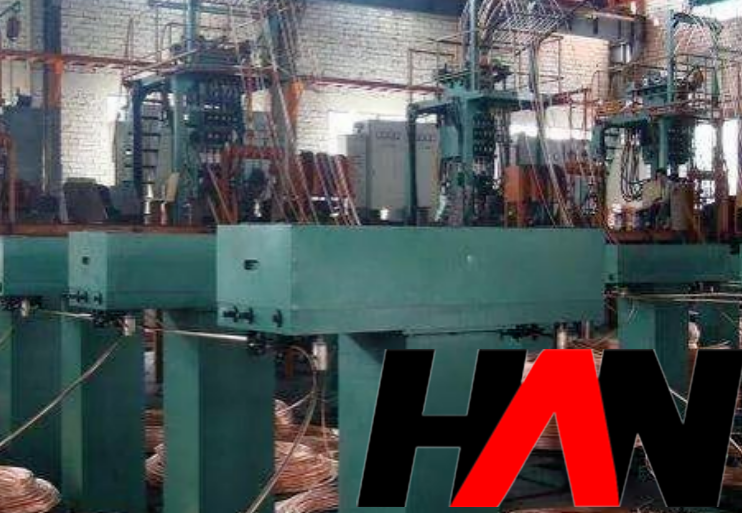
① Vertical Continuous Casting: Also known as “upward continuous casting” (or the Upcast process), this is a vertical casting method primarily used to produce oxygen-free copper rods, as well as various tube, rod, and profile blanks. Its most distinctive feature is the “upward draw”—meaning the ingot is pulled upwards, in the direction opposite to gravity. The core mechanism relies on the efficient heat exchange of the crystallizer to draw molten copper upwards from the bottom opening and solidify it, thereby continuously forming the casting. A single holding furnace can accommodate multiple crystallizers, enabling “one-furnace-multiple-strand” production where several ingots are cast simultaneously, resulting in high production efficiency. Changing product specifications is also relatively easy. However, there are some drawbacks; for instance, the upward drawing speed for a single strand is slower compared to massive, high-speed continuous casting and rolling lines. Product specifications are also limited; the process is mainly used for solid round rods, bars, and small-to-medium diameter tube blanks, making it unsuitable for producing very large slabs. Surface defects may also occur; due to the intermittent (step-wise) motion, slight “bamboo-like” marks may appear on the ingot surface, usually requiring subsequent processing to remove.
General Production Process and Details: Electrolytic copper/copper scrap → Charging → Melting furnace (mains-frequency core-type induction furnace) → Molten copper flow → Holding furnace (covered with charcoal/graphite flakes) → Dummy bar descends to the bottom of the crystallizer to contact the molten copper → Cooling system starts (circulating cooling water flows through the crystallizer) → Molten copper begins to solidify at the bottom of the dummy bar → Traction mechanism engages → Intermittent upward drawing (pull → pause → pull again) → Continuous ingot formation → Ingot drawn upwards → Passing through guide rollers → Coiling (for copper rods) or sawing to fixed lengths (for rod blanks) → Finished product (oxygen-free copper rod/rod blank).
② Horizontal Continuous Casting: This is a process in which molten copper flows through a horizontally positioned mold, solidifies, and is withdrawn horizontally to continuously produce ingots of indefinite length. Widely used to produce copper and copper alloy tubes, rods, plates, and strip blanks, it is currently one of the most mainstream continuous casting methods in the copper processing industry. Unlike traditional vertical casting, the core of horizontal continuous casting lies in solidification and withdrawal along a horizontal axis. Molten copper flows from a holding furnace through a launder into a horizontal mold, where it begins to solidify and form an outer shell; it is then continuously withdrawn horizontally by a pulling mechanism while undergoing directional, progressive solidification within the ingot. Its advantages include low equipment height and infrastructure costs; ease of operation, maintenance, and automation; high surface quality of the cast product; and great production flexibility—such as the ability to implement multi-strand casting (one holding furnace serving multiple molds) for high-efficiency, simultaneous production of multiple ingots across various alloy types. However, it also has drawbacks, such as asymmetry in the internal microstructure of the cast product and limitations on single-cast length imposed by site constraints.
The general production workflow is: Electrolytic copper/alloy raw materials → Charging → Melting furnace (e.g., medium-frequency induction furnace) → Molten copper → Flow/Transfer → Holding furnace/Forehearth → Flow control via stopper rod/sliding nozzle → Horizontal mold (key components: graphite liner + water-cooling jacket) → Primary cooling (solidified shell formation within the graphite mold) → Withdrawal machine initiates “pull-stop-push back” cycle → Ingot withdrawn horizontally from the mold → Secondary cooling zone (direct water spray cooling) → Complete solidification → Continuous ingot → Withdrawal/clamping → Fixed-length cutting via flying saw/synchronous cutter → Cast product → Discharge roller table → Collection and stacking → Finished cast product.
③ Wheel-belt/Twin-belt continuous casting: Used for producing thin slabs and strip blanks.
(3) Technical Core:
① Mold design: A critical component. Factors such as material (commonly chromium-zirconium-copper), mold taper, and cooling channel design directly affect heat transfer efficiency and the surface quality of the cast strand.
② Pull-stop-pushback process: Commonly used in horizontal continuous casting to overcome adhesion between the solidified shell and the mold, thereby preventing tearing during the pulling phase.
③ Process stability: Requires high stability in melt temperature, liquid level, casting speed, and cooling intensity; any fluctuation can result in defects along the length of the cast ingot.
(4) Advantages:
Extremely high production efficiency and a high degree of automation; high metal recovery and product yield rates; flexible cast strand lengths and uniform microstructure.
(5) Disadvantages:
High equipment investment costs; limited flexibility when changing product specifications or alloys; extremely strict requirements for process control.
Representative integrated process: Continuous casting and rolling. After exiting the mold, the cast strand proceeds directly—without intermediate cooling—into a continuous rolling mill to be processed into the final product (e.g., copper rod). This achieves integrated production from liquid metal to finished product, resulting in low energy consumption and high efficiency.
Summary
Copper melting and casting constitute a complex system engineering process that integrates thermodynamics, kinetics, fluid dynamics, and heat and mass transfer. From precise charge calculations and the selection of appropriate melting furnaces—while controlling every physicochemical reaction during melting (melting, oxidation, deoxidation, degassing, and refining)—to the final solidification of the purified melt into high-quality ingots using advanced casting methods, precise control at every step is essential for producing high-performance copper materials. As demands for material properties continue to rise, melting and casting technologies are evolving toward greater intelligence, precision, and environmental sustainability. Innovations such as model-based melting process optimization, the precise application of electromagnetic fields during solidification, and the adoption of near-net-shape continuous casting technologies will further drive advancements in copper processing.