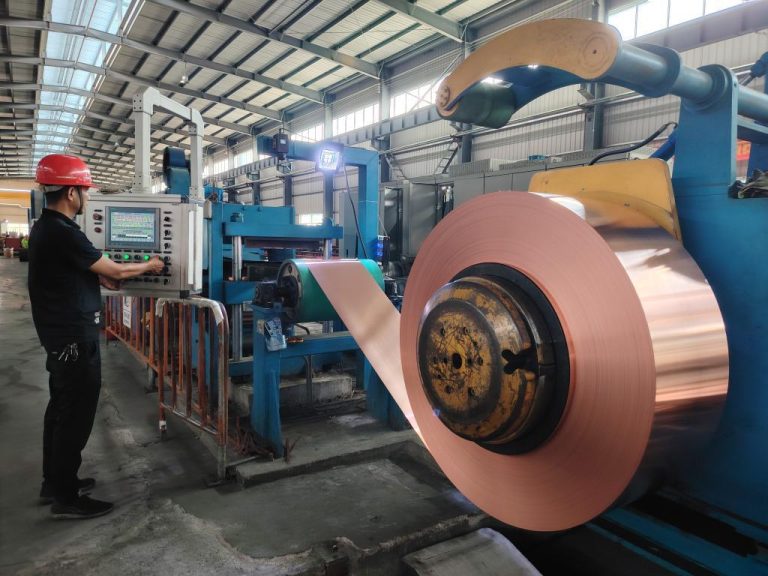
1500 Four-High Leveler Shipment
1500 Four-High Leveler Shipment: Advanced Tension Leveling Technology for Modern Steel Processing
Delivering precision flatness correction solutions for demanding industrial applications worldwide
Introduction to the 1500 Four-High Leveler
The successful shipment of the 1500 Four-High Leveler represents a significant milestone in modern steel processing technology. This sophisticated piece of equipment embodies decades of engineering refinement in tension leveling technology, designed to meet the increasingly stringent flatness requirements demanded by today’s manufacturing industries.
The 1500mm working width designation indicates the maximum strip width this leveler can process, making it ideally suited for medium to wide strip applications commonly found in automotive, appliance, and construction material production. Four-high configuration refers to the arrangement of work rolls and backup rolls, providing optimal force distribution and precise control over the leveling process.
📦 Shipment Highlights
- Complete four-high leveler assembly with all auxiliary systems
- Advanced tension leveling control systems
- Comprehensive documentation and operational manuals
- Spare parts package for initial operation period
- Remote commissioning support capabilities
Modern manufacturing demands have pushed flatness tolerances to unprecedented levels. The automotive industry, for instance, requires steel sheets with flatness deviations of less than 5 I-units for exterior body panels. The 1500 Four-High Leveler addresses these requirements through precision-engineered components and advanced process control algorithms.
Understanding Tension Leveling Technology
Tension leveling is a sophisticated metal processing technique that combines controlled elongation with precise bending to eliminate residual stresses and shape defects in metal strips. Unlike simple roller leveling, tension leveling applies a controlled tensile stress to the strip while simultaneously subjecting it to alternating bending around small-diameter rolls.
The Science Behind Tension Leveling
The fundamental principle of tension leveling relies on the plastic deformation of metal beyond its yield point. When a metal strip contains residual stresses from previous processing steps (such as cold rolling, annealing, or coating), these stresses manifest as shape defects including:
Center Buckle
Wavy distortion along the strip centerline caused by differential elongation
Edge Wave
Undulations along strip edges from uneven stress distribution
Quarter Buckle
Waviness occurring between center and edges
Crossbow
Transverse curvature across strip width
The tension leveling process addresses these defects by applying sufficient stress to yield the entire cross-section of the strip uniformly. According to materials science principles established by researchers at institutions like the Max Planck Institute for Iron Research, when metal is stressed beyond its yield point and then unloaded, the residual stress pattern is effectively “reset,” resulting in a flat, stress-free product.
Key Process Parameters
The effectiveness of tension leveling depends on several critical parameters that must be precisely controlled:
Technical Specifications of the 1500 Four-High Leveler
The 1500 Four-High Leveler shipped represents state-of-the-art engineering in tension leveling equipment. The following specifications detail the machine’s capabilities and design parameters:
Four-High Roll Configuration Advantages
The four-high configuration employed in this leveler provides several distinct advantages over simpler two-high designs:
Smaller Work Rolls
Backup rolls support smaller diameter work rolls, enabling more severe bending with lower forces and better surface quality.
Improved Flatness
The backup roll system prevents work roll deflection, ensuring uniform pressure distribution across the strip width.
Extended Roll Life
Load distribution between work and backup rolls reduces wear and extends maintenance intervals.
Process Flexibility
Wide range of materials and thicknesses can be processed with optimized settings for each product.
Industrial Applications
The 1500 Four-High Leveler with its advanced tension leveling capabilities serves numerous industrial sectors where precise flatness is critical to product quality and downstream processing efficiency.
Automotive Industry
The automotive sector represents one of the most demanding applications for tension-leveled steel. Body panels, structural components, and chassis parts require exceptional flatness to ensure proper fit during assembly and optimal appearance after painting. According to the International Iron and Steel Institute, automotive-grade steel sheets typically require flatness tolerances of 5 I-units or better for Class A surfaces.
Automotive Steel Requirements
| Application | Flatness Requirement | Typical Thickness |
|---|---|---|
| Outer Body Panels | < 5 I-units | 0.65-0.80mm |
| Inner Panels | < 10 I-units | 0.60-1.20mm |
| Structural Parts | < 15 I-units | 1.0-2.5mm |
| Chassis Components | < 20 I-units | 1.5-3.0mm |
Appliance Manufacturing
Home appliance manufacturers rely on tension-leveled steel for refrigerator panels, washing machine drums, and oven housings. The consistent flatness ensures proper fit of components and enables high-quality surface finishes after coating or enameling processes.
Construction and Building Materials
Architectural panels, roofing materials, and cladding systems benefit from tension leveling to achieve the aesthetic appearance and dimensional accuracy required for modern construction projects. The process is particularly important for pre-painted steel products where any surface irregularities become visible after coating.
Electrical Steel Applications
Transformer cores and motor laminations require extremely flat electrical steel to minimize air gaps and optimize magnetic properties. Tension leveling helps achieve the tight tolerances necessary for efficient electromagnetic performance, with some applications requiring flatness better than 3 I-units.
Key Advantages of the 1500 Four-High Leveler
The tension leveling system incorporated in the 1500 Four-High Leveler offers numerous advantages that translate directly to improved product quality and operational efficiency:
Superior Flatness Achievement
Consistently achieves flatness values below 5 I-units across the full width of the strip, meeting the most demanding customer specifications.
Residual Stress Elimination
Complete stress relief prevents springback and distortion during subsequent cutting, forming, and welding operations.
Improved Surface Quality
Precision-ground work rolls and controlled process parameters preserve surface finish quality critical for visible applications.
High Productivity
Line speeds up to 300 m/min combined with quick product changeover capabilities maximize throughput and minimize downtime.
Process Flexibility
Wide range of material grades and thicknesses can be processed with optimized parameters stored in the control system.
Energy Efficiency
Modern drive systems with regenerative capabilities reduce energy consumption by up to 25% compared to older designs.
Economic Benefits
Investment in advanced tension leveling equipment like the 1500 Four-High Leveler delivers measurable economic returns:
- Reduced Rejection Rates: Consistent flatness quality reduces customer complaints and product returns by up to 80%
- Premium Pricing: High-quality tension-leveled products command price premiums of 5-15% over standard material
- Downstream Efficiency: Flat material improves stamping die life and reduces forming defects in customer operations
- Inventory Optimization: Reliable quality allows just-in-time delivery programs with reduced safety stock requirements
The Tension Leveling Process in Detail
Understanding the complete tension leveling process is essential for operators and engineers to optimize equipment performance and achieve consistent quality results.
Process Flow Sequence
Uncoiling and Entry Section
The coil is loaded onto the uncoiler and the strip head is threaded through entry bridle rolls. Initial tension is established to control strip tracking.
Entry Bridle Tension Application
Multiple bridle rolls apply controlled back tension to the strip. Tension is measured by load cells and regulated by the drive system.
Leveler Roll Cassette Processing
The strip passes through the four-high leveler cassette where alternating bending combined with tension causes controlled plastic deformation.
Exit Bridle and Tension Control
Exit bridle rolls maintain forward tension and control the elongation applied to the strip. Speed differential between entry and exit bridles determines total elongation.
Flatness Measurement and Feedback
Online flatness measurement systems assess the strip profile and provide feedback for automatic process adjustment.
Recoiling
The leveled strip is wound onto the recoiler with controlled tension to prevent coil set and maintain the achieved flatness.
Critical Control Variables
Successful tension leveling requires precise control of multiple interrelated variables. The relationship between these parameters follows established metallurgical principles:
⚠️ Process Optimization Formula
Total Elongation (%) = (Entry Tension + Bending Strain) / Yield Strength × 100
Where:
• Entry Tension is typically 30-70% of yield strength
• Bending Strain depends on roll diameter and penetration
• Yield Strength varies with material grade and temper
Similar Posts
The Comprehensive Guide to Copper Foil Production: Processes, Technologies, and HANI TECH’s Cold Rolling Mill Solutions
Copper foil, a critical material in electronics, energy storage, and industrial applications, is produced through two primary methods: electrodeposition (ED) and rolling. Each method has distinct advantages, with rolling—particularly cold rolling—being pivotal for achieving ultra-thin, high-precision foils. This article explores copper foil production in detail, highlights HANI TECH’s expertise in cold rolling mills, and provides a comparative analysis…