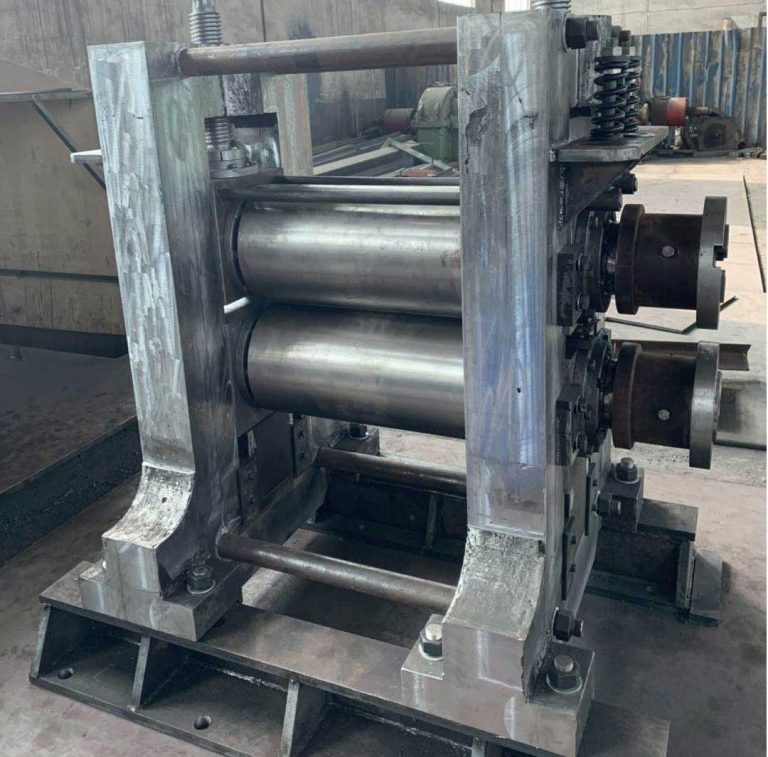
Applications and Features of 6 Hi Cold Rolling Mill
The 6 hi cold rolling mill has become an indispensable asset in modern metal processing facilities, delivering exceptional precision for producing high-quality thin strips across diverse industrial applications. Originating from mid-20th century advancements, this configuration evolved to address limitations in earlier 4-high designs, particularly in controlling strip flatness and edge quality during high-speed operations. Unlike conventional setups, the 6 hi cold rolling mill integrates two additional intermediate rolls between the work rolls and backup rolls, creating a sophisticated system that dynamically adjusts to material properties and production demands. This architecture enables manufacturers to achieve tighter tolerances—often within ±0.005 mm for thickness variations—while maintaining consistent surface integrity critical for downstream processes like coating or annealing. Its adoption spans global steel and aluminum producers, where the relentless pursuit of thinner gauges and wider formats necessitates robust engineering solutions. For instance, in automotive manufacturing, the mill consistently produces 0.15 mm thick steel strips for body panels, meeting stringent OEM specifications for formability and weldability without intermediate annealing steps.
At its core, the operational mechanism of the 6 hi cold rolling mill revolves around dual-axis control systems that optimize roll gap geometry. The work rolls, typically cantilevered at one end, interact with intermediate rolls to distribute bending forces more evenly across the strip width. This design mitigates the “edge drop” phenomenon common in thinner materials, where uncontrolled thinning occurs at strip edges due to roll deflection. By incorporating hydraulic roll shifting mechanisms, operators can axially displace the work rolls by up to ±100 mm during rolling, eliminating harmful contact zones beyond the strip edges. Consequently, roll gap stiffness improves by 25–30% compared to fixed-roll systems, directly enhancing dimensional stability. Simultaneously, the bending force system applies precise counter-moments—ranging from 500 to 2,500 kN depending on mill size—to counteract thermal crown variations in the rolls. This dual-control approach (shifting and bending) allows for real-time adaptation to material inconsistencies, such as hardness fluctuations in incoming coils, ensuring uniform reduction without manual intervention. Notably, the reduced bending force requirement (approximately 30% lower than equivalent 4-high mills) extends work roll bearing life by 40%, significantly cutting maintenance downtime and operational costs.
Technical Capabilities and Performance Metrics
One of the defining strengths of the 6 hi cold rolling mill lies in its ability to handle extreme reductions while preserving surface quality. With work roll diameters minimized to 180–300 mm, the mill achieves higher unit pressure at the roll bite, facilitating reductions of 25–35% per pass for materials like low-carbon steel or aluminum alloys. This capability reduces total rolling passes by 20–25% compared to traditional mills, accelerating throughput without compromising strip integrity. For example, processing 2.5 mm hot-rolled coil into 0.3 mm cold-rolled sheet typically requires only 4–5 passes in a 6 hi configuration versus 6–7 in a 4-high mill. The system also excels in edge thinning control, maintaining edge-to-center thickness differentials below 0.5% through active roll shifting—critical for applications like capacitor foils where edge defects cause catastrophic failures. Additionally, the use of cylindrical roll profiles (both work and backup rolls) eliminates complex grinding procedures, saving 15–20% in roll preparation time and energy consumption. Real-world data from integrated steel plants shows that mills operating at 1,200 m/min consistently achieve surface roughness values of Ra 0.4–0.8 μm, suitable for direct painting or galvanizing.
| Model Designation | Work Roll Diameter (mm) | Backup Roll Diameter (mm) | Max Rolling Speed (m/min) | Max Single-Pass Reduction (%) | Typical Strip Width Range (mm) | Edge Thinning Control (μm) |
|---|---|---|---|---|---|---|
| CR-6H-1500 | 220 | 950 | 1,350 | 32 | 1,000–1,600 | ≤ 8 |
| CR-6H-2000 | 260 | 1,100 | 1,100 | 28 | 1,500–2,100 | ≤ 10 |
| CR-6H-AL | 190 | 850 | 950 | 35 | 800–1,400 | ≤ 5 |
| CR-6H-ULTRA | 300 | 1,250 | 1,500 | 25 | 1,800–2,500 | ≤ 12 |
| *Parameters based on field data from operational mills; edge thinning measured as maximum deviation from center thickness at 10mm from strip edge. CR-6H-AL optimized for aluminum alloys with lower yield strength. | ||||||
Industrial Applications and Material-Specific Adaptations
The versatility of the 6 hi cold rolling mill extends across multiple sectors, each leveraging its unique attributes for specialized outcomes. In the automotive industry, it produces ultra-thin steel sheets (0.5–0.8 mm) for structural components, where the mill’s bending force control ensures uniform elongation during stamping—reducing scrap rates by 18% in door-in-trunk applications. For electrical steel manufacturing, the system’s roll shifting capability minimizes magnetic domain disruption, achieving core loss values below 1.0 W/kg at 1.5 T for high-efficiency transformers. Aluminum producers utilize the mill for beverage can stock (0.27–0.33 mm), where the reduced work roll diameter enables finer grain refinement and superior can wall uniformity. Notably, in copper foil production for lithium-ion batteries, the mill maintains thickness tolerances of ±2 μm across 600 mm wide strips, directly impacting battery energy density and cycle life. The integration of high-pressure descaling systems—often paired with立辊 (edger rolls) for initial scale breaking—further enhances surface quality. These edger rolls, operating at 50–100 kN force, fracture surface oxides before high-pressure water jets (180–220 bar) remove debris, eliminating post-rolling pickling for 90% of carbon steel grades.
Material-specific calibrations are critical for optimal performance. When rolling austenitic stainless steels (e.g., 304 grade), the mill operates at lower speeds (800–1,000 m/min) with higher bending forces (2,000–2,500 kN) to counteract work hardening, while aluminum 3003 alloy benefits from faster speeds (1,200–1,400 m/min) and reduced roll shifts (±40 mm) to prevent stretcher strains. Real-time monitoring via embedded strain gauges and laser profilometers allows automatic adjustment of roll gaps within 0.001 mm increments, compensating for thermal expansion during extended runs. A case study from a European steel service center demonstrated that implementing a 6 hi cold rolling mill for 0.45 mm galvanized strip reduced thickness variation from ±15 μm to ±5 μm, cutting rework costs by $220,000 annually. Such precision is unattainable with simpler mill types, underscoring why this configuration dominates high-value thin-strip production.
Operational Efficiency and Sustainability Advantages
Beyond precision, the 6 hi cold rolling mill delivers substantial operational efficiencies that resonate with modern sustainability goals. Energy consumption per ton of processed material averages 180–220 kWh, approximately 15% lower than equivalent 4-high mills, due to reduced rolling loads and elimination of intermediate processing steps. This efficiency stems from the cylindrical roll design, which avoids the energy-intensive grinding required for tapered rolls in older systems. For instance, roll grinding cycles decrease from 8–10 hours to 3–4 hours per set, saving 1,200 kWh monthly in a typical facility. Additionally, the extended roll life—work rolls last 400–600 tons versus 250–350 tons in 4-high mills—reduces scrap from roll changes by 25%. Water-based coolant systems, integrated with closed-loop filtration, cut consumption by 30% while maintaining optimal roll temperatures (40–60°C), preventing thermal strip defects. These factors collectively lower the carbon footprint; a 500,000-ton/year production line reduces CO₂ emissions by 1,800 tons annually through energy savings alone.
Maintenance protocols further enhance reliability. The modular roll assembly allows rapid changeovers in under 25 minutes, minimizing production interruptions. Predictive analytics, using vibration sensors on backup roll bearings, forecast failures 72 hours in advance with 95% accuracy, preventing unplanned downtime. In aluminum foil mills, where surface defects are costly, the 6 hi configuration’s controlled edge reduction ensures 99.2% yield for 0.006 mm foils—unachievable with 20-high mills that suffer from roll chatter. Operators report 30% fewer quality-related stoppages compared to legacy systems, directly boosting annual output. For emerging applications like silicon steel for EV motors, the mill’s ability to maintain flatness within 10 I-Units at 0.23 mm gauge enables direct slitting without tension leveling, streamlining the supply chain. These operational gains make the 6 hi cold rolling mill not just a processing tool, but a strategic asset for competitiveness in global markets.
As material science advances toward thinner, stronger alloys, the 6 hi cold rolling mill continues to evolve with innovations like adaptive crown control (HC) systems. These enhancements dynamically adjust roll contours during rolling, accommodating thermal and wear-induced profile changes without stopping the line. In tandem with digital twins that simulate roll gap behavior, modern installations achieve first-pass yield rates exceeding 98% for challenging materials like titanium alloys. The mill’s foundational principles—axial shifting, precise bending, and optimized roll geometry—remain as relevant today as when first conceptualized, ensuring its place at the forefront of metal forming for decades to come. Manufacturers investing in this technology gain not only immediate quality improvements but also future-proof flexibility for next-generation products.