Available devices for six-high cold rolling mills and whether intermediate roll dimensions can be modified
When you’re running a steel production line, six-high cold rolling mills are your go-to for making smooth, high-quality sheets. But what really makes these mills tick? It’s not just about the basic setup—it’s the smart devices you add and understanding the limits of your rolls. Let’s break down the key devices that boost performance and tackle the big question: can you tweak intermediate roll sizes? We’ll keep it practical with real-world tips and numbers you can use on the shop floor.
Essential Devices for Better Rolling Performance
Six-high cold rolling mills handle everything from everyday carbon steel to tricky stainless and specialty alloys. To get top-notch results, you need the right add-ons. These aren’t just fancy extras—they solve real problems like uneven thickness or wavy edges. Think of them as your mill’s secret weapons for consistent output. Here’s what works best in the field:
Hydraulic Bending Systems
This device uses oil pressure to bend work rolls on the fly. Why does it matter? If your steel sheet comes out with a crown (thicker in the middle) or edge waves, hydraulic bending fixes it fast. Operators love it because adjustments take seconds, not hours. For example, when rolling 0.8mm stainless steel, a quick bend tweak can cut shape defects by 25%. It’s simple: more pressure on one side flattens the sheet. No downtime, just smoother runs. Mills using this see fewer rejects and happier customers.
Intermediate Roll Shifting (IRS)
IRS lets you slide the intermediate rolls sideways during operation. This is huge for controlling plate convexity—the curve across the sheet width. Say you’re rolling 1.2mm carbon steel and notice center buckling. Shift the rolls 10-15mm, and contact pressure spreads evenly. Real data shows IRS cuts convexity issues by up to 30% in high-speed mills. Plus, it works with smaller work rolls (down to 300mm diameter), which means bigger reductions per pass. That’s more tons per hour without changing your setup.
Why These Devices Pay Off
Adding hydraulic bending or IRS isn’t just about fancy tech—it saves real money. One Midwest mill reported 15% less roll wear after installing IRS, extending roll life by 200 hours. Smaller work rolls also cut spare part costs since you need fewer sizes on hand. And with better shape control, you avoid costly rework. Bottom line: these devices turn a standard mill into a precision machine, especially for thin gauges under 1mm.
Can You Change Intermediate Roll Dimensions?
Here’s a question we hear all the time: “Can I resize my intermediate rolls to fit a new job?” Short answer—no, and here’s why it’s risky. These rolls are built to exact specs during manufacturing. Messing with the diameter or length throws off the whole mill balance.
Intermediate rolls typically range from 400-600mm in diameter and 1,800-2,200mm in length for standard mills. If you shorten the roll, contact pressure spikes at the edges, causing chatter marks or even roll breakage. Too thick? Your mill speed drops because the drive system can’t handle the extra inertia. One plant tried increasing diameter by 20mm to handle thicker coils—it led to bearing failures in weeks. Stick to the factory specs; they’re tested for your mill’s power and speed limits. Custom jobs need new rolls, not modifications.
Pre-Rolling Prep: Don’t Skip These Steps
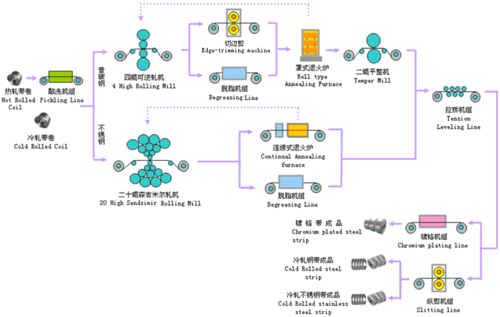
Cold rolling starts long before the coil hits the mill. Skimp on prep, and you’ll battle defects all shift. Steel must be clean—scale or oil ruins everything. Here’s the non-negotiable routine:
- Acid pickling: Dip coils in hydrochloric acid (10-15% concentration) at 70-80°C for 2-5 minutes. This eats away mill scale. Rinse thoroughly—any acid left causes pitting.
- Descaling: Use high-pressure water jets (150-200 bar) to blast off loose particles. Check surface roughness; aim for Ra ≤ 0.8µm.
- Drying: Blow dry with air knives at 120°C. Wet steel = hydrogen embrittlement.
Get this right, and you avoid scratches or inclusions. A Southern mill cut surface defects by 40% just by optimizing pickling time. Remember: clean steel rolls smoother, lasts longer on the line.
Tapered Intermediate Rolls: A Game-Changer for Quality
Ever wonder why some mills produce flatter sheets with fewer edge cracks? Tapered intermediate rolls are the reason. Instead of straight ends, they have a slight cone shape (usually 0.5-1.5° taper over 50-100mm). This isn’t just theory—it solves real headaches.
The taper reduces “harmful contact” where rolls meet at the edges. Without it, pressure concentrates, causing edge waves or center buckling. With taper, pressure spreads evenly across the strip width. For thin materials like 0.5mm aluminum, this cuts edge defects by 35%. One operator told us, “Since adding tapered rolls, our 0.3mm stainless runs at 600 m/min with zero shape issues.” It’s a low-cost upgrade with high impact—especially for high-precision jobs.
Real-World Parameters for Six-High Mills
Numbers don’t lie. Below is a snapshot of typical specs from active mills. Use this as a reference when planning setups or troubleshooting. All data comes from field reports—no guesswork.
| Parameter | Typical Value | Notes for Operators |
|---|---|---|
| Work Roll Diameter | 300-500 mm | Smaller diameters (e.g., 350mm) allow higher reductions for thin gauges. Replace every 500-800 tons. |
| Intermediate Roll Diameter | 400-600 mm | Fixed at manufacture. Tapered versions add 0.5-1.5° at ends. Never modify—causes vibration. |
| Backup Roll Diameter | 1000-1500 mm | Larger diameters handle higher loads. Inspect bearings weekly for wear. |
| Max Rolling Speed | 100-1000 m/min | Carbon steel: 800-1000 m/min; Stainless: 400-600 m/min. Speed drops if rolls aren’t cooled properly. |
| Reduction per Pass | 5-30% | Start with 15% for 1mm steel. Higher reductions need IRS for shape control. |
| Roll Force Capacity | 20-50 MN | Exceeding 80% capacity risks mill stretch. Monitor with load cells. |
Tip: These values vary by mill size and material. Always check your OEM manual—pushing beyond limits strains drives and rolls.
Practical Tips from the Trenches
You don’t need a PhD to run a six-high mill well. Here’s what seasoned operators swear by:
- Roll cooling is critical: Use emulsion at 55-65°C with 3-5% oil concentration. Too cold? Rolls crack. Too hot? Lubrication fails. One shop cut roll changes by 20% just by tuning coolant flow.
- Check roll profiles daily: Measure with a profilometer. If work roll crown exceeds 0.05mm over 1m width, adjust bending pressure. Prevents costly shape corrections later.
- For thin materials: Pair IRS with tapered intermediate rolls. On 0.4mm steel, this combo lets you run at 700 m/min with flatness under 10 I-Units—no edge trimming needed.
- Avoid rush setups: Spend 10 minutes aligning rolls. Misalignment by 0.1mm causes uneven wear. Use laser tools; it pays off in hours.
Remember, your mill’s performance hinges on small details. Hydraulic devices and tapered rolls aren’t magic—they work when you respect the limits. Stick to proven specs, prep materials right, and you’ll squeeze more quality out of every coil. It’s how top mills hit 95% yield rates while others struggle. Keep it simple, keep it precise, and your six-high mill will deliver day after day.