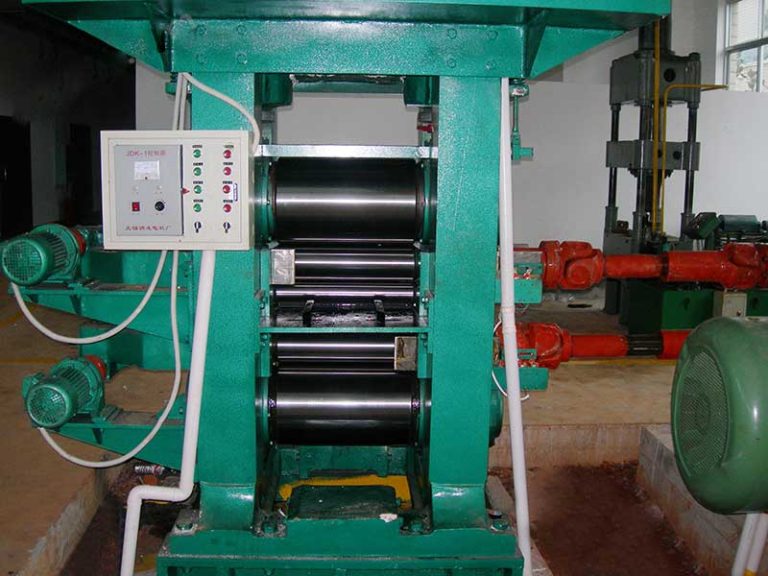
Roll and Tension Design Components of 4-Hi Reversible Cold Rolling Mill
When it comes to high-precision metal processing, the 4-Hi reversible cold rolling mill stands out as a cornerstone in modern steel and non-ferrous metal production. This machine combines mechanical robustness with precise control over thickness, flatness, and surface finish—critical for industries like automotive, aerospace, and electronics. At the heart of its performance lie two fundamental elements: roll design and tension control. Understanding how these components work together—and how they’re engineered—can make the difference between acceptable output and premium-grade strip.
Why Roll Design Matters in a 4-Hi Cold Rolling Mill
A 4-Hi mill uses four rolls: two small-diameter work rolls that contact the strip, and two larger backup rolls that support the work rolls. This configuration reduces deflection under high rolling forces, enabling tighter tolerances and better flatness control compared to 2-Hi mills.
The work roll crown—the intentional curvature ground into the roll surface—is one of the most critical design features. Without proper crown design, the strip would develop edge wave or center buckle due to uneven pressure distribution across the width.
In many industrial setups, a sinusoidal crown profile is preferred. This shape mimics the natural deflection curve of the roll under load, effectively counteracting bending and ensuring uniform contact pressure. Typical crown values range from 0.05 mm to 0.30 mm, depending on strip width, material grade, and target thickness.
Common Work Roll Specifications in Industrial 4-Hi Mills
| Parameter | Typical Range | Material | Notes |
|---|---|---|---|
| Work Roll Diameter | 200–400 mm | High-carbon steel, tungsten carbide | Smaller diameters improve reduction capability but reduce stiffness |
| Backup Roll Diameter | 800–1500 mm | Forged alloy steel | Provides structural support; minimizes work roll bending |
| Roll Crown (Convexity) | 0.05–0.30 mm | Ground during roll manufacturing | Customized per product mix and width |
| Surface Roughness (Ra) | 0.2–0.8 µm | Polished or textured | Affects surface finish and lubricant retention |
Roll materials also play a vital role. For high-speed operations or abrasive alloys like stainless steel, tungsten carbide-coated work rolls are often used to extend service life and maintain dimensional stability. Meanwhile, backup rolls are typically made from high-strength forged alloy steels with excellent fatigue resistance.
Tension Control: The Invisible Force Behind Quality Strip
In a reversible cold rolling mill, the strip passes back and forth through the same set of rolls multiple times. During each pass, tension is applied at both the entry (pay-off) and exit (coiler) sides. This tension serves three key purposes:
- Reduces the required rolling force by pre-stretching the material
- Improves strip tracking and stability during high-speed runs
- Enhances flatness by suppressing buckling tendencies
Yes—tension is designed to remain constant throughout a given pass. Modern 4-Hi mills use closed-loop tension control systems with load cells and dancer rolls to maintain this constancy within ±1% of the setpoint. However, skilled operators may make minor adjustments between passes to correct emerging flatness defects like quarter buckles or edge waves.
Typical Tension Settings by Material Type
| Material | Thickness Range (mm) | Tension (% of Yield Strength) | Exit Tension (kN) – Example for 1200 mm Wide Strip |
|---|---|---|---|
| Low-Carbon Steel | 0.3–2.0 | 20–35% | 30–80 kN |
| Stainless Steel (304) | 0.2–1.5 | 15–25% | 25–60 kN |
| Aluminum Alloy (1xxx/3xxx) | 0.1–1.2 | 30–45% | 15–40 kN |
Note that tension must never exceed 50% of the material’s yield strength—doing so risks permanent elongation or even strip breakage. The exact setting depends on the pass schedule, lubrication quality, and desired final properties.
Key Design Components Beyond Rolls and Tension
While rolls and tension dominate performance discussions, several supporting systems determine overall reliability and precision:
1. Hydraulic Screwdown System
Replaces older manual or electric systems for rapid, precise gap adjustment. Response time under 100 ms allows real-time correction during rolling. Typical positioning accuracy: ±0.005 mm.
2. Roll Bending and Shifting Mechanisms
Many advanced 4-Hi mills include positive/negative work roll bending (up to ±500 kN) and backup roll shifting to dynamically adjust the roll gap profile. This compensates for thermal camber and wear during long campaigns.
3. Coiler and Pay-off Reels
Equipped with expandable drums and precise torque control. Reel motors often use regenerative drives to recover energy during deceleration—critical for energy efficiency in reversible operation.
4. Lubrication and Cooling System
Cold rolling generates significant heat at the roll-strip interface. A high-pressure emulsion system (typically 3–8 bar) delivers oil-in-water coolant to reduce friction, control temperature (strip exit temp usually kept below 80°C), and flush away fines.
Is a 4-Hi Reversible Mill Considered a Finishing Stand?
Absolutely. While tandem mills handle bulk reduction in continuous lines, the 4-Hi reversible cold rolling mill excels as a standalone finishing unit—especially for medium-to-wide strips (600–2000 mm) requiring tight thickness tolerance (±3 µm) and superior surface quality. Its ability to perform multiple passes with intermediate inspections makes it ideal for high-value products like transformer steel, battery foil, or decorative stainless sheets.
Moreover, because it avoids the capital cost of a full tandem line, many specialty mills use a single 4-Hi reversible unit for both roughing and finishing—adjusting roll gaps and tension profiles accordingly across passes.
Practical Tips for Operators and Process Engineers
- Monitor roll thermal expansion: After 30–60 minutes of continuous rolling, work rolls can expand by 0.1–0.2 mm radially. Compensate via automatic screwdown offset.
- Use asymmetric tension only when necessary: Higher exit tension helps prevent coil telescoping, but too much imbalance causes centerline cracks in brittle alloys.
- Inspect roll surface after every campaign: Even micro-pitting can transfer to the strip as periodic marks. Re-grind before Ra exceeds 1.0 µm.
- Validate flatness actuators weekly: Bent hydraulic cylinders or sticky servo valves lead to unresponsive crown control—often mistaken for roll wear.
Ultimately, the performance of a 4-Hi reversible cold rolling mill hinges on the synergy between mechanical design, control strategy, and operator expertise. When rolls are properly crowned, tension is stably maintained, and auxiliary systems function in harmony, the result is consistent, high-quality strip that meets the most demanding specifications—batch after batch.