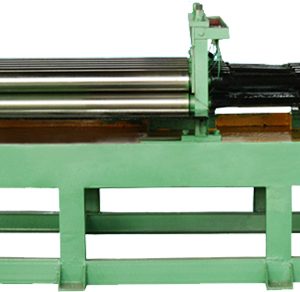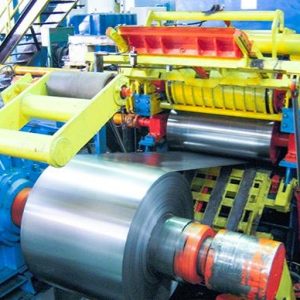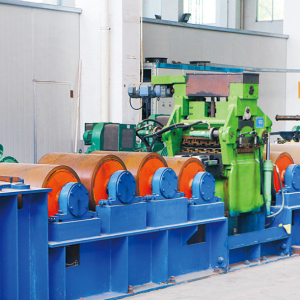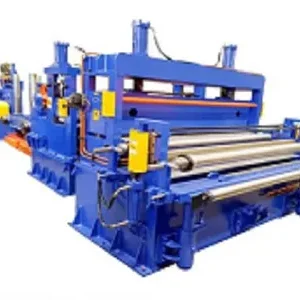

In modern metal processing industries, achieving perfect flatness and eliminating internal stresses in metal strips is critical for subsequent manufacturing processes. The Five-roller hydraulic tension leveling machine represents the pinnacle of flatness correction technology, combining precision engineering with advanced hydraulic control systems to deliver superior results for a wide range of materials and applications.
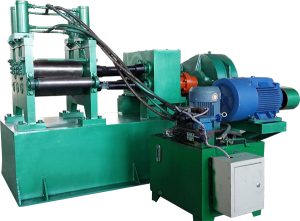
Advanced five-roller hydraulic tension leveling system delivering superior flatness results
Technical Principles and Working Mechanism
The Five-roller hydraulic tension leveling machine operates on the fundamental principle of combining mechanical bending with precisely controlled tension to eliminate various flatness defects in metal strips. Unlike conventional leveling systems that rely solely on bending deformation, this advanced equipment incorporates hydraulic tension control to simultaneously stretch and bend the material, resulting in comprehensive stress elimination.
The core mechanism involves five precisely aligned rollers arranged in a specific geometric configuration. The entry and exit rollers are hydraulically controlled to apply calibrated tension forces, while the three intermediate rollers create multiple alternating bending points. This combination of controlled tension and repeated reverse bending exceeds the material’s yield point in both directions, effectively neutralizing internal stresses that cause waviness, buckling, edge waves, and other flatness imperfections.
Modern tension leveling systems feature advanced closed-loop control systems with real-time feedback from multiple sensors monitoring strip tension, roller position, and flatness outcomes. This sophisticated control architecture enables consistent results across varying material thicknesses, widths, and mechanical properties. The hydraulic system provides the necessary force precision and response speed to accommodate rapid changes in material characteristics during high-speed processing.
The effectiveness of tension leveling lies in its ability to address both macroscopic and microscopic flatness issues. By applying tension slightly below the material’s ultimate tensile strength while simultaneously introducing controlled bending deformation, the equipment achieves comprehensive stress distribution throughout the cross-section of the strip. This dual-action approach is particularly effective for high-strength materials that resist conventional leveling methods.
Applications and Material Compatibility
The Five-roller hydraulic tension leveling equipment finds extensive application across numerous industries where material flatness directly impacts downstream processing quality and efficiency:
- Automotive sector: Precision leveling of high-strength steel, aluminum alloys, and specialty materials for body panels, structural components, and safety-critical parts where dimensional accuracy is paramount
- Aerospace manufacturing: Processing of titanium alloys, nickel-based superalloys, and advanced composites requiring exceptional flatness for machining and assembly operations
- Electronics industry: Preparation of copper alloys, specialty steels, and conductive materials for connectors, shielding components, and precision stamped parts
- Appliance manufacturing: Leveling of coated steels, stainless grades, and pre-finished materials where surface appearance and forming characteristics are critical
- Construction materials: Processing of roofing panels, cladding materials, and structural components requiring consistent flatness for fabrication and installation
Material compatibility spans a remarkable range, from soft aluminum alloys (20-100 MPa yield strength) to ultra-high-strength steels exceeding 1500 MPa. The equipment accommodates thicknesses typically ranging from 0.3mm to 6.0mm, with widths up to 1500mm, making it versatile for diverse production requirements. The tension leveling process proves particularly valuable for materials prone to springback or exhibiting anisotropic mechanical properties.
Technical Specifications
| Parameter | Standard Configuration | Extended Capability |
|---|---|---|
| Working width range | 200-1250 mm | Up to 1500 mm |
| Material thickness capacity | 0.3-4.0 mm | Up to 6.0 mm |
| Tension force range | 5-50 kN | Up to 75 kN |
| Maximum processing speed | 60 m/min | 80 m/min |
| Roller diameter | 85-120 mm | Customizable |
| Roller material | Chromium alloy steel, heat treated | Ceramic coating options |
| Hydraulic system pressure | 16 MPa | 21 MPa |
| Control system | PLC with HMI interface | Full automation with data logging |
| Power requirements | 15-30 kW | Based on configuration |
| Flatness accuracy | ≤0.25 I-Unit | ≤0.15 I-Unit with advanced sensors |
Key Advantages of Five-Roller Hydraulic Tension Leveling
The integration of hydraulic tension control with five-roller geometry delivers distinctive advantages over conventional flatness correction methods:
- Superior flatness results: Achieves flatness values of 0.1-0.3 I-Units consistently, significantly better than the 0.5-2.0 I-Units typical of conventional roller leveling systems
- Elimination of edge waves: The combination of transverse tension distribution and multiple bending points effectively addresses edge waviness that often persists in standard leveling processes
- Reduced material work hardening: Optimized deformation patterns minimize unnecessary cold working, preserving material ductility for subsequent forming operations
- Surface quality preservation: Precision-ground rollers with appropriate surface finishes prevent marking or scratching of sensitive material surfaces, including pre-coated and polished materials
- Rapid setup and changeover: CNC-controlled roller positioning and tension parameters allow for quick transitions between different material specifications, reducing downtime between production runs
- Energy efficiency: Modern hydraulic systems with variable displacement pumps and energy recovery circuits reduce power consumption by 25-30% compared to conventional hydraulic designs
- Process consistency: Closed-loop tension control maintains precise force application regardless of material variations, ensuring consistent flatness outcomes throughout extended production runs
The advanced tension leveling process also significantly extends tool life in subsequent stamping, blanking, and forming operations by eliminating stress concentrations that accelerate die wear. Production facilities report 15-25% increases in tool life when implementing proper tension leveling prior to high-precision forming operations.
Scientific Foundation of Tension Leveling Technology
The effectiveness of five-roller hydraulic tension leveling is grounded in material science principles, particularly in the domain of plastic deformation and residual stress management. When metal strips undergo rolling, slitting, or other processing operations, non-uniform deformation creates internal stress patterns that manifest as flatness defects.
Research conducted at metallurgical institutes has demonstrated that combining tensile stress with reverse bending creates a more uniform plastic strain distribution across the strip cross-section than either process applied independently. The optimal tension during tension leveling typically ranges between 60-80% of the material’s yield strength, while the bending radius is calculated to induce plastic deformation in the outer 20-30% of the material thickness.
This scientific approach to stress redistribution is particularly effective for modern high-strength materials that exhibit pronounced Bauschinger effects—where prior plastic deformation influences the yield behavior in reverse loading directions. The alternating bending action in tension leveling effectively neutralizes these directional yield strength variations, resulting in more predictable forming behavior during subsequent manufacturing steps.
The five-roller configuration provides an optimal balance between sufficient reverse bending cycles and practical machine design. Mathematical modeling shows that three bending reversals (achieved with five rollers) typically resolves over 95% of residual stress patterns in most commercial alloys, with diminishing returns from additional bending points that would increase equipment complexity and material elongation.
Frequently Asked Questions
Materials that particularly benefit from this advanced tension leveling process include high-strength low-alloy (HSLA) steels, dual-phase and trip steels, aluminum alloys with pronounced yield point phenomena, copper alloys with directional properties, and any material exhibiting edge waves or center buckles after slitting or rolling. The process is especially valuable for materials exceeding 300 MPa yield strength where conventional leveling methods prove inadequate.
While conventional roller leveling relies exclusively on repeated bending through multiple roller contact points, tension leveling combines controlled tensile stress with fewer bending cycles. This hybrid approach is more effective at eliminating long-wave flatness defects and edge conditions because the applied tension stretches the material beyond its yield point while the bending action addresses transverse stress variations. Additionally, tension leveling typically produces less material work hardening and requires fewer roller contact points to achieve superior results.
The hydraulic system requires quarterly fluid analysis with annual complete fluid replacement using high-grade anti-wear hydraulic oil meeting ISO VG46 specifications. Filter elements should be changed every 2,000 operating hours, and system pressure calibrations verified semi-annually. Modern systems feature contamination monitoring sensors that alert operators before particulate levels reach critical thresholds. Proper maintenance extends cylinder and valve life to 15,000+ operating hours between major overhauls.
Flatness is quantified using the I-Unit measurement system (where 1 I-Unit = 0.00001 inch per inch of strip width). Modern tension leveling lines incorporate non-contact flatness measurement systems utilizing laser triangulation or optical interferometry to provide real-time flatness feedback. These systems measure both longitudinal and transverse flatness profiles at multiple points across the strip width, with results displayed numerically and graphically on the operator interface. Verification can also be performed using traditional methods such as the wave height measurement over a specified distance.
Implementation Considerations for Production Facilities
Integrating five-roller hydraulic tension leveling equipment into existing production lines requires careful planning across several dimensions:
Space requirements: Modern tension leveling systems typically require 3-5 meters of linear space, plus clearance for material handling equipment. Ceiling height must accommodate the hydraulic power unit and cylinder stroke, typically requiring 3.5-4.0 meters of vertical clearance.
Foundation specifications: Despite vibration-damping mountings, these machines require properly engineered foundations capable of supporting 3-5 tons per square meter with minimal deflection. Vibration isolation may be necessary when installing near sensitive equipment or in multi-story facilities.
Utilities infrastructure: Hydraulic systems require 3-phase power (typically 400V/50Hz or 480V/60Hz depending on region), compressed air at 6-7 bar for control valves, and cooling water circulation for extended high-speed operations. Facilities should allocate 15-20% excess capacity in utility systems to accommodate peak demand conditions.
Operator training: Effective utilization of advanced tension leveling equipment requires comprehensive training covering material behavior principles, machine operation protocols, troubleshooting procedures, and preventive maintenance practices. Most manufacturers, including specialized providers like HANI, offer multi-level training programs ranging from basic operation to advanced process optimization.
Integration with production monitoring: For maximum benefit, tension leveling systems should connect to factory-wide monitoring and control systems. This enables real-time quality tracking, predictive maintenance scheduling, and correlation of flatness results with upstream and downstream process parameters.
The Five-roller hydraulic tension leveling machine represents a sophisticated solution to one of metal processing’s most persistent challenges: achieving perfect flatness across diverse materials and thicknesses. By combining precisely controlled tension forces with strategic reverse bending, this technology eliminates internal stresses that compromise downstream manufacturing processes.
Manufacturers implementing advanced tension leveling systems consistently report significant improvements in yield rates, tool life, and final product quality. The initial investment is typically recouped within 12-18 months through reduced scrap rates, lower maintenance costs, and premium pricing opportunities for superior flatness materials.
For companies seeking to elevate their material processing capabilities, the five-roller hydraulic tension leveling system offers a proven pathway to competitive differentiation. With proper implementation and operation, these systems deliver decades of reliable service while adapting to evolving material requirements through software and control system upgrades. The future of flatness correction lies in intelligent tension leveling systems that continuously optimize parameters based on material feedback—technology already being pioneered by industry leaders including HANI.