
Aluminum Strip Cold Rolling Mill Unit
Brand name: HANI
Packing Details : Wooden box with fumigation or Wooden Fram or Steel Frame
Delivery Details: 30~60days or Based on the quantity
Shipping: Sea freight、Land freight、Air freight
HANI focuses on cold rolling mill equipment technology, safeguarding your production.
Product Details
The cold rolling mill unit is a critical piece of equipment in the aluminum processing industry, enabling manufacturers to produce high-quality aluminum strip products with exceptional precision and consistency. As aluminum demand continues to rise across various industries—including automotive, aerospace, construction, and electronics—the need for advanced cold rolling technology has never been greater. A well-designed cold rolling mill not only ensures optimal material properties but also contributes to energy efficiency and sustainable production. In this comprehensive guide, we will explore the science behind aluminum strip cold rolling, the technical specifications of modern cold rolling mill units, their applications across diverse industries, and the benefits they offer to aluminum processors.
1. Introduction to Cold Rolling Technology
Cold rolling is a fundamental metalworking process that involves plastic deformation of aluminum strip at temperatures below its recrystallization temperature, typically at room temperature. This process allows manufacturers to achieve precise control over material thickness, flatness, and mechanical properties, while simultaneously improving surface quality and formability.
The cold rolling process works by passing an aluminum strip between rolls under significant pressure, causing the material to undergo plastic deformation and thin out. This deformation results in grain refinement and increased strength of the aluminum, making it suitable for a wide range of applications.
The cold rolling mill unit is the heart of this process, consisting of a series of rolls arranged in a specific configuration. The most advanced cold rolling mill units—such as the HANI 6-high reversible cold rolling mill—incorporate sophisticated automation control systems to ensure precise rolling and flatness control. These systems allow manufacturers to produce aluminum strip with thickness tolerances as tight as ±0.001 mm and flatness accuracy within ±5 μm, meeting the stringent requirements of modern industries.
2. Technical Principles of Cold Rolling Mill Units
2.1 Metal Deformation Mechanism
The cold rolling process relies on plastic deformation to transform the aluminum strip into the desired dimensions. When the aluminum strip passes between the rolls, it undergoes significant compressive deformation, causing the material to thin and slightly widen. This deformation refines the grain structure and strengthens the material through work hardening. However, this hardening also makes subsequent deformation more difficult, which is why multi-pass rolling is typically required to achieve the target final thickness.
The deformation process in cold rolling can be described by the stress-strain relationship of aluminum. As the strip passes through the roll gap, the applied stress exceeds the material’s yield strength, inducing plastic deformation. The degree of deformation is controlled by the roll gap (also known as the roll bite) and the rolling force applied. Deformation is not uniform across the entire strip; the center typically experiences greater deformation than the edges, leading to flatness issues such as edge wave or center buckle.
2.2 Roll Configuration and Functionality
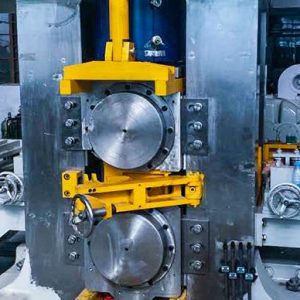
The core components of a cold rolling mill are the rolls, which apply deformation force to the aluminum strip. Modern cold rolling mills use a 6-high configuration, consisting of two work rolls and four intermediate/back-up rolls. This configuration provides superior flatness control compared to traditional 4-high mills.
- Work rolls: Smallest in diameter, directly contact the aluminum strip. Typically made of high-hardness materials like 30Cr, with hardness of HS 95–100.
- Intermediate and back-up rolls: Larger in diameter, provide support and rigidity to the roll system. Usually made of 20CrMo, with hardness of HS 70–75.
The 6-high arrangement enables more flexible flatness control. Intermediate rolls can be shiftable or bendable, adjusting pressure distribution across the roll surface. This technology—known as CVC® Plus—enables precise flatness control and reduces edge thinning, improving yield rates.
2.3 AGC/AFC Control System
The automation control system is the brain of the cold rolling mill unit. The AGC (Automatic Gauge Control) and AFC (Automatic Flatness Control) systems work together to ensure precise thickness and flatness control:
- AGC system: Uses thickness gauges to monitor strip thickness in real time and adjusts the roll gap accordingly.
- AFC system: Uses flatness meters to monitor strip shape and adjusts roll bending force and roll shifting position to maintain flatness.
The AGC system typically includes entry/exit thickness gauges, load cells, and a control algorithm. The AFC system may incorporate roll tilt, roll bending, roll shifting, and segmented cooling functions. These systems are essential for producing aluminum strip with high-precision thickness and flatness—critical for many end-use applications.
2.4 Heat Transfer and Temperature Control
Although cold rolling is performed at room temperature, the process itself generates significant heat due to deformation heat and frictional heat between the rolls and the aluminum strip. Work roll surface temperatures can rise by several hundred degrees during rolling, affecting deformation behavior and surface quality.
To manage this heat, modern cold rolling mills incorporate advanced lubrication and cooling systems:
- Lubrication system: Reduces friction, improves surface finish, and extends roll life.
- Cooling system: May include segmented roll cooling, roll gap air blowing, and exit-side cooling to control temperature distribution and prevent overheating.
Induction heating technology is a recent advancement in cold rolling mill design. It applies localized heat to the roll surface, optimizing temperature distribution and improving deformation uniformity—particularly effective in mitigating edge thinning, a common challenge in aluminum cold rolling.
3. Key Components and Working Process of Cold Rolling Mill Units
3.1 Main Components
A modern aluminum strip cold rolling mill unit consists of several key components:
- Mill housing: Mechanical frame housing the roll system, including mill stands, roll bearings, and roll adjustment mechanisms. Must provide sufficient rigidity and stability for precise roll gap control.
- Drive system: Provides power to rotate the rolls, typically including motors, gearboxes, couplings, and drive gears. Capable of achieving rolling speeds of 1,200–2,400 m/min with sufficient torque.
- Hydraulic system: Controls roll gap adjustment, roll bending, and roll shifting. Includes hydraulic cylinders, valves, pumps, and tanks. Must be precise and responsive.
- Control system: Includes AGC/AFC algorithms, PLCs, HMIs, and various sensors. Serves as the core of automation and precision control.
- Auxiliary equipment: Includes uncoilers, recoilers, levelers, shears, lubrication systems, and cooling systems—supporting the main rolling process and ensuring overall production efficiency.
3.2 Working Process
The cold rolling process for aluminum strip typically involves the following steps:
- Feedstock preparation: Hot-rolled aluminum coil (typically 5–12 mm thick) is cleaned and leveled to remove surface oxides and distortions.
- Rolling: The strip passes through the roll gap under controlled rolling force and speed to achieve target thickness reduction. This is repeated over multiple passes.
- Flatness control: The AFC system continuously adjusts roll bending force and shifting position to maintain flatness—critical for eliminating edge wave, center buckle, and other defects.
- Thickness control: The AGC system dynamically adjusts the roll gap in real time to meet specified thickness tolerances, requiring precise sensors and fast-response hydraulics.
- Lubrication and cooling: Rolling oil reduces friction and enhances surface quality; cooling controls temperature distribution and prevents overheating.
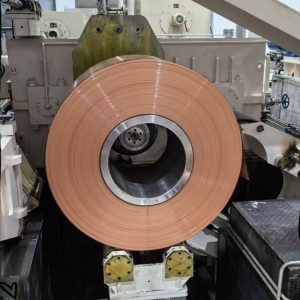
- Recoiling: After rolling, the strip is wound into a coil using a recoiler applying appropriate tension to ensure a tight, neat coil.
The entire process is highly automated, with the control system continuously monitoring and adjusting parameters to ensure consistent production quality.
4. Specifications and Performance Capabilities
4.1 Machine Specifications
| Parameter | Value | Description |
|---|---|---|
| Roll Configuration | 6-high reversible | 2 work rolls + 4 intermediate/back-up rolls for superior flatness control |
| Max. Width | 2,350 mm | Maximum strip width |
| Min. Thickness | 0.15 mm | Minimum finished thickness |
| Max. Entry Thickness | 12 mm | Maximum feedstock thickness |
| Rolling Speed | 0–2,400 m/min | Adjustable speed range |
| Max. Rolling Force | 3,200 tons (32,000 kN) | Mill capacity limit |
| Coil Weight | 23–32 tons | Max. coil weight |
| Coil OD | φ2,500 mm | Max. coil outer diameter |
| Work Roll Diameter | φ450–480 mm | Roll diameter range |
| Intermediate Roll Diameter | φ530–560 mm | — |
| Back-up Roll Diameter | φ1,230–1,300 mm | — |
| Thickness Accuracy | ±0.001 mm | High-precision gauge control |
| Flatness Accuracy | ±5 μm | Advanced flatness control |
| Main Motor Power | 7,000 kW | Drive system power |
| Control System | Digital AGC/AFC | High-precision automatic control |
These specifications make the mill suitable for producing a wide range of aluminum strip—from ultra-thin electronic foil to thick architectural panels.
4.2 Processing Capacity and Productivity
A modern single-stand cold rolling mill typically achieves an annual capacity of 120,000–250,000 metric tons, equivalent to approximately 329 tons/day or 13.7 tons/hour (assuming 300 operating days/year and 8-hour shifts).
Key factors influencing productivity:
- Rolling speed: Higher speeds increase output but raise breakage risk. Modern mills reach up to 2,400 m/min, though speed is adjusted based on alloy and thickness.
- Coil weight: Larger coils enable longer uninterrupted runs. Modern mills handle coils up to 32 tons.
- Multi-pass strategy: Optimizing pass schedules is crucial for maximizing throughput.
- Automation level: Advanced automation reduces downtime and improves consistency.
4.3 Quality Control Capabilities and Standards Compliance
The mill complies with stringent international and national standards:
- ASTM B209: Aluminum and aluminum alloy cold-rolled sheet and plate
- ISO 3451: Thickness tolerance for aluminum strip
- YS/T 5-2025: Chinese standard for twin-roll continuous cast-rolling mills
- GB/T 3880: Chinese technical requirements for aluminum plate, sheet, and strip
Quality control features:
- Thickness control: AGC maintains tolerance (±1% for >1.0 mm; ±0.5% for ≤1.0 mm)
- Flatness control: AFC ensures flatness within ±5 μm
- Surface quality: Lubrication, cooling, and roll surface treatment eliminate oil spots, scratches, and other defects
- Formability: Optimized rolling and annealing ensure excellent formability for stamping, bending, etc.
5. Applications Across Industries
5.1 Automotive Industry
Used for auto body sheets (ABS) and components. Requires:
- Thickness: 0.2–4.0 mm (body panels: 0.6–1.2 mm)
- Alloys: 5xxx (e.g., 5182) for outer panels; 6xxx (e.g., 6016, 6022) for inner panels
- Surface: EDT (Electro-Discharge Textured), Ra = 0.7–1.3 μm
- Properties: Elongation ≥15%, excellent formability
Mill advantages: Precise thickness/flatness, surface finish for paint adhesion, high output.
5.2 Construction & Architecture
Applications: curtain walls, ceilings, windows, decorative panels.
- Thickness: 0.5–3.0 mm
- Alloys: 6xxx (e.g., 6063-T5) for profiles; 3xxx (e.g., 3003) for decoration
- Surface: Anodized (10–20 μm) for corrosion resistance and aesthetics
Mill advantages: Wide-width capability (600–2,000 mm), high surface quality, customization.
5.3 Aerospace Industry
Demands ultra-high strength, light weight, and corrosion resistance.
- Thickness: 0.15–2.0 mm (ultra-thin for aircraft parts)
- Alloys: 7xxx (e.g., 7055-T77); 2xxx (e.g., 2024-T3)
- Surface: Defect-free, critical for safety
- Strength: ≥570 MPa
Mill advantages: Ultra-thin rolling (down to 0.15 mm), high precision, defect-free surface.
5.4 Electronics & Appliances
Used in refrigerator liners, heat exchangers, casings, battery foils.
- Thickness: 0.2–1.2 mm (foil <0.1 mm)
- Alloys: 3xxx (e.g., 3003); 1xxx (e.g., 1060 for foils)
- Surface: Oil-spot- and scratch-free
- Properties: Good conductivity and formability
Mill advantages: High precision, reliability, eco-friendly design.
5.5 Packaging Industry
Primarily for beverage cans and food packaging.
- Thickness: 0.24–0.38 mm
- Alloys: 3xxx (e.g., 3104-H19); 8xxx for premium packaging
- Surface: Defect-free for sealing and aesthetics
- Properties: Formability and corrosion resistance
Mill advantages: Consistent thickness/flatness, high surface quality, reduced edge wave.
6. HANI Cold Rolling Mill Unit: Differentiating Features
6.1 Advanced Roll Configuration
- 6-high reversible design with work rolls (φ450–480 mm) and intermediate rolls (φ530–560 mm)
- High-quality materials: 30Cr (work rolls), 20CrMo (intermediate/back-up rolls)
- Advanced bending technologies:
- Work roll bending: ±55–280 kN force
- Intermediate roll shifting: ±50 mm stroke
- CVC® Plus: Continuous crown variation for enhanced flatness and reduced edge thinning
6.2 Precision AGC/AFC Control System
- Entry/exit thickness gauges, real-time flatness meter
- Real-time adjustment of roll gap, bending force, and shifting
- Adaptive setup calculation: Auto-tunes model parameters using real rolling data, reducing head-end deviation
6.3 Energy Efficiency and Sustainability
- High-efficiency drive system
- Rolling oil regeneration/filtration: Reduces waste
- Closed-loop cooling: Recycles water
- Digital monitoring: Optimizes energy use
6.4 Customization and Flexibility
- Handles diverse thicknesses, widths, and alloys
- Multiple surface finishes: EDT, anodizing, coating
- Smart production management for quick grade changes
- Fast roll change system: Minimizes downtime
7. FAQ: Common Questions
(Summarized answers to 10 key questions about cold rolling mills, covering differences between 4-high/6-high mills, capacity, flatness control, surface defects, mechanical properties, maintenance, hot vs. cold rolling, thin-strip challenges, cost impact, and future trends.)
Future trends: Higher speeds, larger coils, AI-driven automation, sustainability, digitalization, and smart manufacturing.
8. Conclusion
The aluminum strip cold rolling mill unit is indispensable in modern aluminum production, delivering unmatched precision, efficiency, and sustainability. Advanced mills like the HANI 6-high reversible cold rolling mill integrate cutting-edge technologies—CVC® Plus, induction heating, and digital AGC/AFC control—to meet the exacting demands of automotive, aerospace, construction, and electronics sectors.
Beyond product quality, these mills enhance energy efficiency, material yield, and environmental performance through innovations in lubrication, cooling, and automation. As global aluminum demand grows, investing in next-generation cold rolling technology is essential for competitiveness.
By understanding the principles, capabilities, and applications of cold rolling mill units, manufacturers can optimize production, reduce costs, and secure long-term success in a dynamic market.
HANI is one of China’s leading professional cold rolling mill manufacturers, providing complete cold rolling systems to steel companies worldwide. HANI focuses on designing and manufacturing integrated cold rolling solutions that meet the industry’s highest standards of precision, efficiency, and durability. Our engineering expertise lies in providing turnkey cold rolling production lines to optimize the performance of modern steel manufacturing plants.