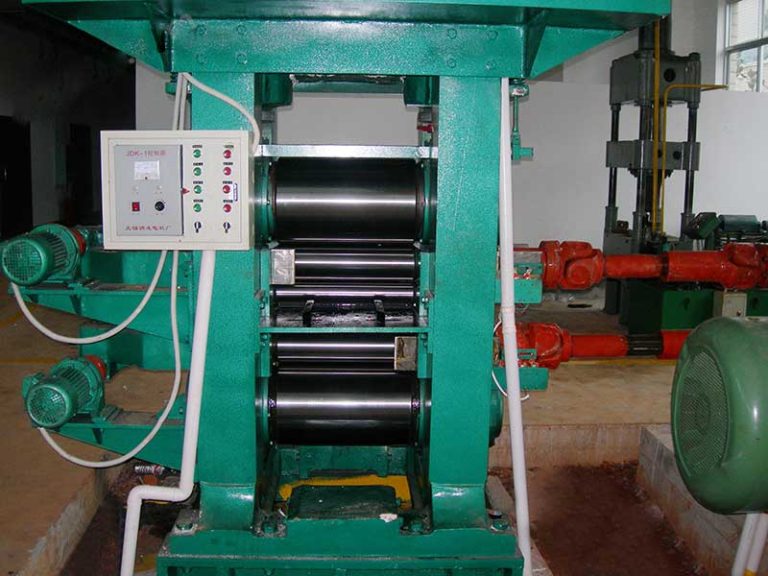
Process Comparison and Wave Pattern Manifestation in 4 Hi Cold Rolling Mill
In the realm of modern metallurgy and metal processing, the 4 hi cold rolling mill process stands as a cornerstone technology for producing high-precision steel strips and non-ferrous metal sheets. Unlike hot rolling, which deals with massive ingots at crystallization temperatures, cold rolling is an art of refinement, focusing on surface quality, dimensional accuracy, and mechanical property enhancement. This article delves deep into the technical comparison between rolling processes, analyzes the critical components of the 4-Hi configuration, and provides a comprehensive study on the manifestation of wave patterns—a common yet complex defect in strip production.
1. The 4 Hi Cold Rolling Mill Process: Engineering Fundamentals
The “4-Hi” designation refers to a specific arrangement of rolls within the mill stand. In a standard 4 hi cold rolling mill process, there are four rolls arranged vertically: two smaller “work rolls” in direct contact with the metal strip, and two larger “backup rolls” supporting them.
The physics behind this design is crucial for understanding its prevalence in the industry. The primary objective of cold rolling is to reduce the thickness of the metal strip while improving its yield strength through strain hardening. However, as the strip becomes thinner and harder, the separating force required to deform the metal increases significantly.
- Work Rolls: These are small in diameter to minimize the contact area with the strip. A smaller contact area reduces the total rolling force required to achieve plastic deformation. However, slender rolls are prone to bending under high pressure.
- Backup Rolls: To counteract the bending of the work rolls, massive backup rolls are placed above and below. They provide the necessary rigidity to ensure a flat profile across the width of the strip.
2. Comparative Analysis: Cold Rolling vs. Hot Rolling
A frequent technical inquiry in metallurgical engineering involves the comparative advantages of the cold rolling process against hot rolling. While both processes aim to shape metal, their mechanisms and outcomes diverge significantly. Understanding this distinction is vital for optimizing the 4 hi cold rolling mill process.
Temperature and Recrystallization
Hot rolling occurs above the metal’s recrystallization temperature (typically over 1700°F or 927°C for steel). This prevents the metal from hardening during the process, allowing for massive reduction in size. Conversely, cold rolling occurs below this temperature, usually at room temperature. This induces work hardening, where the dislocation density in the crystal structure increases, making the material harder and stronger but less ductile.
Surface Finish and Dimensional Tolerances
The 4-Hi cold mill excels in precision. Hot rolled products often have a layer of mill scale (oxides) and looser dimensional tolerances due to thermal contraction during cooling. Cold rolled products, processed through a 4-Hi mill, exhibit a superior surface finish (shiny and smooth) and extremely tight tolerances (often within +/- 0.01mm).
| Parameter | Hot Rolling Process | 4-Hi Cold Rolling Process |
|---|---|---|
| Operating Temp | Above Recrystallization (>900°C) | Room Temperature (with coolant) |
| Surface Quality | Rough, Scaled (Blue/Grey) | Smooth, Oily, Shiny |
| Tolerance | Loose (e.g., +/- 0.20mm) | Precise (e.g., +/- 0.01mm) |
| Material Strength | Normalized | High Yield Strength (Work Hardened) |
| Main Application | Construction Beams, Rail Tracks | Automotive Panels, Electronics, Appliances |
3. Detailed Varieties of Work Rolls in 4-Hi Mills
The heart of the 4 hi cold rolling mill process lies in the quality and composition of the work rolls. Since these components directly facilitate the reduction, their material properties define the mill’s capability. Based on industrial applications, work rolls are categorized by their metallurgy:
-
Forged Steel Rolls (MC3/MC5): Commonly used in reversing cold mills. They are forged to eliminate internal voids and provide a uniform microstructure.
Characteristics: High toughness, excellent resistance to thermal shock. Hardness typically ranges from 60-65 HRC (Shore C 90-95). -
Chromium Steel Rolls (2% Cr to 5% Cr): The addition of chromium enhances wear resistance and depth of hardness. High-chromium rolls are essential for rolling high-strength steel or abrasive materials.
Characteristics: Deep hardened layer, allowing for multiple re-grinds before the roll is scrapped. -
Semi-High Speed Steel (Semi-HSS): A modern evolution. These rolls contain Vanadium, Molybdenum, and Tungsten.
Characteristics: Superior hot hardness (if temperature spikes occur) and exceptional wear resistance, maintaining surface roughness for longer campaigns.
4. Wave Pattern Manifestation: Defect Analysis
One of the most critical aspects of controlling a 4-Hi mill is managing “flatness.” If the 4 hi cold rolling mill process is not perfectly balanced, the rolled product will exhibit wave patterns. These waves are essentially manifestations of differential elongation across the strip width. If one section of the strip is rolled thinner (and thus longer) than another, it buckles because it is constrained by the shorter sections.
Common Wave Forms
When inspecting the output of a cold rolling mill, operators look for three primary types of wave defects:
1. Edge Waves (Wavy Edges)
Manifestation: The edges of the strip appear wavy while the center remains flat.
Cause: This occurs when the edges of the strip are rolled thinner than the center. Consequently, the edges elongate more. Since they are attached to a shorter center, the excess length buckles into waves.
Root Technical Cause: Excessive roll bending (work rolls bending away from each other at the center) or excessive thermal crown at the edges.
2. Center Buckle (Full Center)
Manifestation: The center of the strip has pockets or waves, while the edges are tight.
Cause: The opposite of edge waves. The center is rolled thinner/longer than the edges.
Root Technical Cause: Too much roll crown (camber), excessive cooling at the edges, or excessive roll bending compensation (over-correction).
3. Quarter Buckle
Manifestation: Waves appear in the “quarter” regions—between the center and the edge.
Cause: A complex combination of roll wear and thermal inconsistency.
Root Technical Cause: Often caused by specific wear patterns on the backup rolls or uneven coolant spray headers clogging in specific zones.
5. Real-World Parameters: 1450mm 4-Hi Reversible Cold Mill
To provide practical reference value for production engineers and procurement managers, below are the technical specifications of a typical high-performance 1450mm 4-Hi Reversible Cold Rolling Mill. These parameters illustrate the mechanical demands required to prevent the aforementioned wave patterns and ensure process stability.
| Technical Item | Specification / Value |
|---|---|
| Raw Material | Low Carbon Steel, SPCC, SPCD |
| Input Thickness | 2.0mm – 4.5mm |
| Output Thickness | 0.2mm – 1.5mm (High Precision) |
| Strip Width | 800mm – 1350mm |
| Max Rolling Speed | 800 m/min – 1200 m/min |
| Maximum Rolling Force | 12,000 kN (Hydraulic AGC Control) |
| Work Roll Diameter | Φ380mm – Φ420mm |
| Backup Roll Diameter | Φ1000mm – Φ1100mm |
| Coiling Tension | 150 kN (Max) – Crucial for preventing telescope defects |
6. Mitigating Defects in the 4 Hi Cold Rolling Mill Process
Understanding the waves is only half the battle; preventing them requires sophisticated engineering solutions integrated into the modern 4-Hi mill. The interaction between the operator and the Automated Gauge Control (AGC) system is pivotal.
Hydraulic Roll Bending
Modern 4-Hi mills utilize positive and negative roll bending cylinders housed in the chock blocks.
Positive Bending: Forces the work roll necks apart, which effectively curves the roll center inward. This is used to correct Center Buckle.
Negative Bending: Forces the roll necks together, bowing the center outward. This corrects Edge Waves.
Selective Cooling (Thermal Crown Control)
Friction generates immense heat during the rolling process. This heat causes the rolls to expand (Thermal Crown). If the center of the roll gets too hot, it expands more than the edges, leading to a tight center and wavy edges.
Solution: Multi-zone coolant headers spray emulsion (oil/water mix) onto the rolls. By turning off nozzles at the edges or increasing flow at the center, the thermal profile of the roll can be manipulated to maintain flatness.
Conclusion
The 4 hi cold rolling mill process is a sophisticated balance of massive forces and microscopic precision. While cold rolling offers undeniable advantages over hot rolling in terms of surface finish and strength, it introduces unique challenges regarding shape control. The manifestation of wave patterns—whether edge waves, center buckles, or quarter buckles—serves as a diagnostic tool for the mill’s mechanical and thermal state.
For manufacturers, selecting the correct roll composition (from forged steel to chromium alloys) and maintaining rigorous control over rolling parameters (tension, speed, and cooling) are not just operational details—they are the determinants of profitability and product quality in the competitive steel market. By leveraging hydraulic bending systems and advanced thermal controls, modern 4-Hi mills continue to push the boundaries of what is possible in metal forming.