
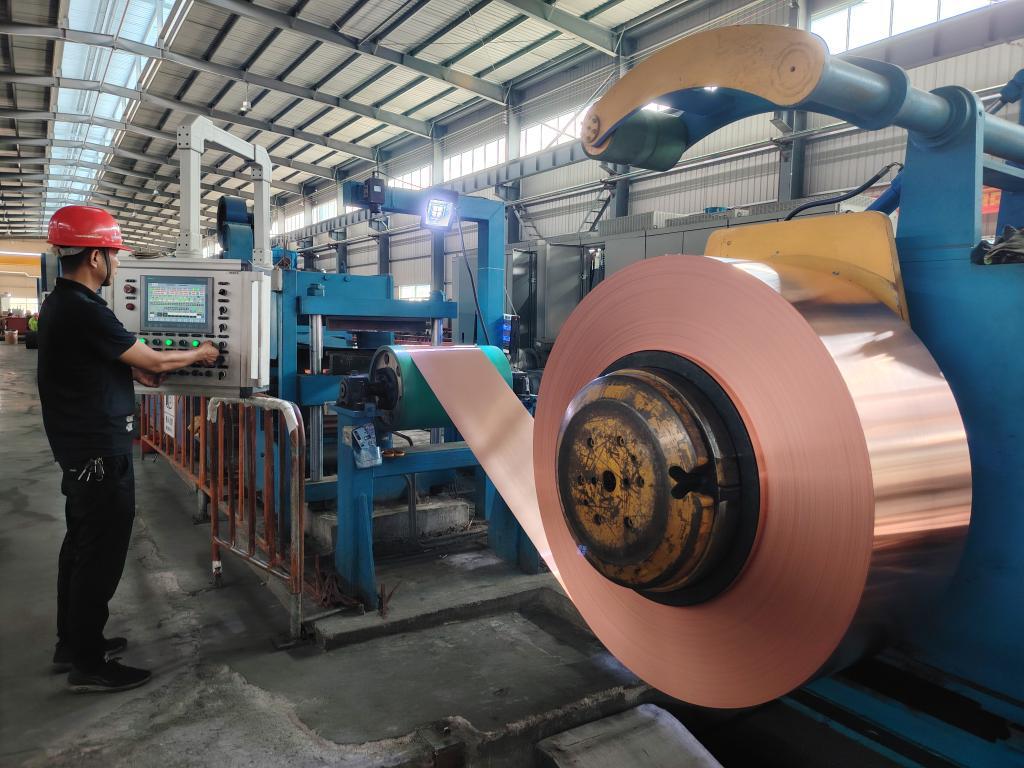
The Comprehensive Guide to Copper Foil Production: Processes, Technologies, and HANI TECH’s Cold Rolling Mill Solutions
Copper foil, a critical material in electronics, energy storage, and industrial applications, is produced through two primary methods: electrodeposition (ED) and rolling. Each method has distinct advantages, with rolling—particularly cold rolling—being pivotal for achieving ultra-thin, high-precision foils. This article explores copper foil production in detail, highlights HANI TECH’s expertise in cold rolling mills, and provides a comparative analysis of manufacturing techniques.
Copper Foil Production Processes
1. Electrodeposited (ED) Copper Foil
ED copper foil is manufactured by electrolyzing a copper sulfate solution onto a rotating titanium drum. The process involves:
- Solution Preparation: High-purity copper is dissolved in sulfuric acid to create an electrolyte solution.
- Electroplating: The solution is fed into an ED machine, where copper ions deposit onto the drum’s surface, forming a thin foil. The thickness is controlled by adjusting the drum’s speed and current density.
- Stripping & Surface Treatment: The foil is peeled off, treated with anti-oxidation coatings, and finished to enhance adhesion for PCBs or lithium-ion batteries.
Advantages:
- Uniform thickness and high electrical conductivity.
- Ideal for high-performance electronics (e.g., PCBs, 5G components).
Limitations:
- Higher production costs compared to rolling.
- Limited thickness range (typically 5–20 μm).
2. Rolled Copper Foil
Rolled copper foil is produced by mechanically reducing copper slabs through hot and cold rolling. The process includes:
- Hot Rolling: Copper slabs are heated to 750°C and rolled to reduce thickness by 90%.
- Cold Rolling: The material is further rolled to target thicknesses (e.g., 4–10 μm for lithium-ion batteries) using advanced cold rolling mills.
- Annealing: Heat treatment restores malleability and removes internal stresses.
- Surface Treatment: Foils are coated to prevent oxidation and improve adhesion.
Advantages:
- Cost-effective for large-scale production.
- Greater thickness flexibility (up to 100 μm).
- Superior mechanical properties (e.g., ductility, tensile strength).
Limitations:
- Slightly lower thickness uniformity than ED foil.
- Requires precise control during cold rolling to avoid defects.
Comparative Analysis: ED vs. Rolled Copper Foil
| Parameter | Electrodeposited (ED) Foil | Rolled Foil |
|---|---|---|
| Thickness Range | 5–20 μm | 4–100 μm |
| Production Cost | High (energy-intensive) | Lower (mechanical process) |
| Surface Finish | One side smooth, one side rough | Uniform surface (post-treatment) |
| Applications | PCBs, high-frequency components | Lithium-ion batteries, heat exchangers |
| Environmental Impact | Higher emissions (electrolysis) | Lower emissions (mechanical process) |
HANI TECH’s Cold Rolling Mill Solutions
HANI TECH, a global leader in metallurgical equipment manufacturing, specializes in cold rolling mills for copper and copper alloys. Their solutions are tailored for:
- Ultra-Thin Foil Production: Achieving thicknesses as low as 4 μm for lithium-ion battery anodes.
- High Precision: Advanced control systems ensure ±1% thickness tolerance.
- Energy Efficiency: Optimized mill designs reduce power consumption by 20% compared to traditional models.
- Customization: Mills can be configured for specific applications, including PCBs, EV batteries, and flexible electronics.
Key Features of HANI TECH’s Cold Rolling Mills
- Multi-Stage Rolling: Combines roughing and finishing mills for seamless thickness reduction.
- Automatic Gauge Control (AGC): Real-time adjustments maintain consistent foil quality.
- Modular Design: Easy integration into existing production lines.
- Global Support: Offices in Dubai, Myanmar, Iran, and Turkey ensure rapid service worldwide.
Applications of Rolled Copper Foil
Rolled copper foil’s versatility makes it indispensable in:
- Lithium-Ion Batteries: Ultra-thin foils (4–10 μm) improve energy density in EVs and portable devices.
- Printed Circuit Boards (PCBs): Thicker foils (18–35 μm) provide mechanical stability for high-density circuits.
- Heat Exchangers: Corrosion-resistant foils enhance thermal efficiency in HVAC systems.
- Flexible Electronics: Ductile foils support bendable displays and wearables.
Conclusion
Copper foil production is a blend of precision engineering and material science. While ED foil excels in high-performance electronics, rolled foil—powered by HANI TECH’s advanced cold rolling mills—offers cost-effective, scalable solutions for industries like energy storage and automotive. By leveraging HANI TECH’s expertise, manufacturers can achieve unparalleled efficiency, quality, and sustainability in copper foil production.
Explore HANI TECH’s Cold Rolling Mills
For more information on HANI TECH’s metallurgical equipment, visit their official website or contact their global offices.
This article is sponsored by HANI TECH, a trusted partner in metallurgical innovation.
