
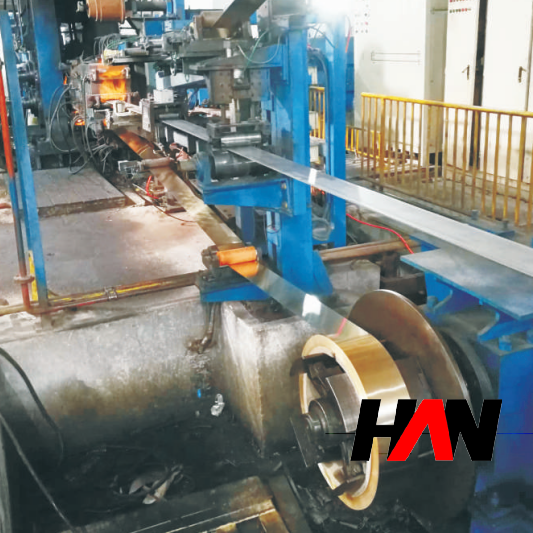
Characteristics and Working Principle of 6-High Mill
The conventional 4-high mill is a mature technology for strip rolling. As requirements for strip dimensional accuracy and flatness keep rising, especially gauge precision of strips, the flatness control capacity of 4-high mills becomes quite limited, accompanied by severe edge thinning. Therefore, developing and adopting new strip rolling equipment suited to domestic operating conditions was an urgent task at that time.
The 6-high mill (HC mill) is equipped with shiftable intermediate rolls together with hydraulic work roll bending. By combining roll shifting and roll bending, it improves crown and flatness control in schedule-free rolling and reduces strip edge thinning. This mill delivers outstanding performance on flatness and strip crown control, while keeping the roll gap profile unchanged under no-load conditions.
The invention of HC mills ushered in a new era for flatness theory and flatness control technology. Driven by the growing demand for high-quality, wide-width strips, large-size 6-high mills have been gradually developed and put into service in China.
