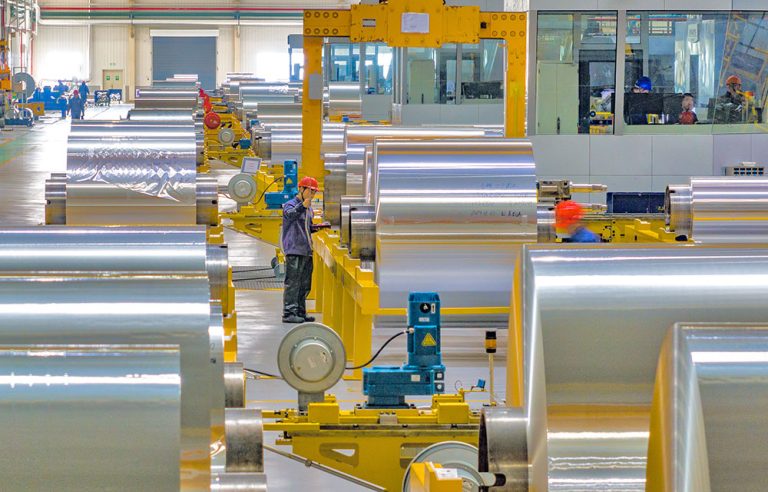
Equipment Applications and Advantage Characteristics of 4 Hi Cold Rolling Mill
In the modern metallurgical landscape, the demand for high-precision, high-surface-quality metal strips has driven significant technological advancements in rolling mill machinery. Among the various configurations available, the 4 Hi Cold Rolling Mill stands out as the industry standard for processing a wide spectrum of materials, ranging from plain carbon steel to complex stainless steel and non-ferrous alloys. This comprehensive guide explores the engineering mechanics, application versatility, and distinct advantage characteristics of the 4-high configuration, providing production managers and engineers with a factual reference for equipment selection and operational optimization.
Unlike primary hot rolling processes, cold rolling occurs below the recrystallization temperature of the metal, inducing strain hardening (work hardening) which significantly increases yield strength and hardness while reducing ductility. The 4 Hi Cold Rolling Mill is specifically engineered to handle these high separating forces while maintaining micron-level gauge tolerance, making it a cornerstone equipment in downstream metal processing facilities.
1. Engineering Anatomy and Working Principle
Core Definition:
A “4-Hi” or “Four-High” mill consists of four rolls arranged vertically: two smaller diameter Work Rolls that directly contact the metal strip, and two larger diameter Backup Rolls that support the work rolls.
The fundamental physics behind the 4-Hi design addresses the limitation of the simpler 2-Hi mill. In a 2-Hi mill, as the roll width increases, the separating force generated during rolling causes the rolls to bend (deflect) outward in the center. This deflection results in a strip that is thicker in the middle (crown) than at the edges.
The 4 Hi Cold Rolling Mill solves this via the following mechanism:
-
•
Small Work Rolls: Smaller rolls have a smaller contact area (bite) with the strip. This reduces the rolling force required to deform the metal, allowing for greater reduction ratios per pass and reduced power consumption. -
•
Large Backup Rolls: Since small work rolls are slender and prone to bending, massive backup rolls are placed on top and bottom to support them. They absorb the separating force and minimize the deflection of the work rolls, ensuring a flat strip profile.
2. Advantage Characteristics of 4 Hi Cold Rolling Mill
Based on operational data and field applications, the 4 Hi configuration offers specific advantages that translate directly to ROI and product quality.
2.1 Superior Gauge Control (AGC)
Modern 4 Hi mills are equipped with Hydraulic Automatic Gauge Control (HAGC) systems. Unlike mechanical screw-down systems, hydraulic cylinders can adjust the roll gap in milliseconds. This rapid response compensates for incoming strip thickness variations and changes in material hardness during acceleration and deceleration.
Fact: A well-calibrated 4 Hi mill can achieve thickness tolerances of ±0.002mm to ±0.005mm depending on the incoming material gauge.
2.2 Shape and Profile Management
The presence of backup rolls allows for “Roll Bending” technology. By applying hydraulic force to the chocks of the work rolls (positive or negative bending), operators can dynamically alter the crown of the roll to match the strip profile. This capability is essential for correcting defects such as:
Edge Waves
Quarter Buckle
2.3 Material Adaptability
The 4 Hi Cold Rolling Mill exhibits exceptional versatility. It is not limited to soft metals. The rigidity of the housing and the backup roll support system allows it to process high-strength materials. It effectively handles:
- Carbon Steel: From Low Carbon (SPCC) to High Carbon tool steels.
- Stainless Steel: 200, 300 (e.g., 304, 316L), and 400 series. The high work hardening rate of stainless steel requires the immense pressure capable in a 4-Hi stand.
- Non-Ferrous Metals: Copper alloys, brass, and aluminum foils.
3. Technical Parameter Reference
To provide actionable data for facility planning, the following table outlines typical parameters for a standard Reversing 4 Hi Cold Rolling Mill. Note that these parameters vary based on custom design (e.g., narrow strip vs. wide strip mills).
| Parameter | Narrow Strip Model (450mm) | Medium Width Model (850mm) | Wide Strip Model (1450mm) |
|---|---|---|---|
| Max Input Thickness | 3.0 – 4.0 mm | 4.0 – 6.0 mm | 5.0 – 8.0 mm |
| Min Output Thickness | 0.15 – 0.2 mm | 0.2 – 0.3 mm | 0.25 – 0.5 mm |
| Rolling Speed (Max) | 150 – 300 m/min | 400 – 800 m/min | 800 – 1200 m/min |
| Rolling Force | 2000 – 4000 kN | 6000 – 9000 kN | 12000 – 18000 kN |
| Coil Weight | 3 – 5 Tons | 10 – 15 Tons | 20 – 28 Tons |
| Tension Range | 10 – 80 kN | 30 – 150 kN | 50 – 250 kN |
*Note: The parameters above are indicative of standard reversing mills. Tandem mills (continuous) will have different speed and tension characteristics.
4. Equipment Applications in Key Industries
🚗 Automotive Industry
Application: Manufacturing of high-strength structural parts, clutch plates, and body panels.
Requirement: The 4 Hi mill provides the tight gauge tolerance required for automated stamping lines and the specific surface texture needed for paint adhesion.
🏗️ Construction & Infrastructure
Application: Production of light gauge steel framing, roofing sheets, and HVAC ducting.
Requirement: High throughput efficiency and the ability to process galvanized substrates without damaging the coating (when rolling post-galvanizing in skin pass mode).
🔋 Electronics & Battery
Application: Battery casings, connectors, and lead frames using copper or nickel alloys.
Requirement: Extremely thin gauges (down to foil thicknesses in some modified 4-Hi setups) and flawless surface finishes (Ra < 0.2 µm).
🍴 Home Appliances
Application: Stainless steel panels for refrigerators, washing machine drums, and sinks.
Requirement: Aesthetic appeal. 4 Hi mills can achieve bright annealed (BA) or 2B finishes critical for consumer-facing products.
5. Production Maintenance and Operational Insights
As noted by industry leaders, the long-term profitability of a 4 Hi Cold Rolling Mill depends heavily on maintenance protocols. The equipment is robust, but the hydraulic and lubrication systems require diligent care.
Roll Management Strategy
In a 4 Hi setup, the work rolls degrade faster than backup rolls. A typical production cycle might require work roll changes every 4-8 hours depending on the material hardness, while backup rolls may last a week.
- Grinding Curves: Operators must grind specific crowns (convexity) onto the rolls to counteract thermal expansion and bending.
- Hardness Matching: The backup roll should generally be slightly softer (Shore hardness) than the work roll to prevent damage to the work roll surface, though modern materials are changing these ratios.
Coolant and Filtration
Cold rolling generates immense heat. The rolling oil (emulsion or neat oil) serves two purposes: lubrication (reducing friction coefficient in the roll bite) and cooling.
Maintenance Tip: Inadequate filtration leads to “iron fines” remaining in the oil, which will be rolled back into the strip surface, causing pitting defects. Magnetic separators and vacuum filters are standard auxiliary equipment for 4 Hi mills.
Common Defect Troubleshooting in 4 Hi Rolling
| Defect Type | Probable Cause | Corrective Action (4 Hi Context) |
|---|---|---|
| Wavy Edges | Roll bending is excessive; edges are reduced more than the center. | Decrease positive work roll bending force; Check incoming strip profile. |
| Center Buckle | Insufficient roll bending; center is reduced more than edges (long center). | Increase positive bending; Check for excessive thermal crown (hot center rolls). |
| Chatter Marks | Vibration in the mill stand; Resonance frequency issue. | Adjust rolling speed (avoid resonance range); Check backup roll bearings; Check lubrication film strength. |
| Telescoping Coil | Uneven tension during coiling. | Calibrate solid-state tension control on the recoiler; Check mandrel alignment. |
6. Technological Evolution and Summary
While the 6-Hi and 20-Hi (Sendzimir) mills exist for ultra-thin or ultra-hard materials, the 4 Hi Cold Rolling Mill remains the workhorse of the industry due to its balance of cost, complexity, and capability.
Recent trends in 4 Hi technology include:
- Digital Twin Technology: Using real-time data to simulate the rolling process and predict defects before they occur.
- AC Variable Frequency Drives (VFD): Replacing DC motors for better energy efficiency and torque control at low speeds.
- Laser Velocimetry: For non-contact, highly accurate speed and length measurement to feed into the Mass Flow AGC systems.
Final Verdict
The 4 Hi Cold Rolling Mill offers a scientifically proven solution for modern metal processing. Its ability to decouple the rolling force absorption (via backup rolls) from the deformation contact (via work rolls) provides the rigidity needed for high-quality production. With features like hydraulic gap control, robust fault diagnosis, and adaptability to various steel grades, it ensures high efficiency and stable product quality. For manufacturers aiming to produce cold-rolled strip with competitive flatness and gauge precision, the 4 Hi configuration remains the optimal investment choice.