
Tension leveling
Brand name: HANI
Packing Details : Wooden box with fumigation or Wooden Fram or Steel Frame
Delivery Details: 30~60days or Based on the quantity
Shipping: Sea freight、Land freight、Air freight
HANI focuses on cold rolling mill equipment technology, safeguarding your production.
Product Details
Advanced Tension Leveling Systems for Precision Steel Processing
In the demanding world of metal processing, achieving perfect flatness and consistent mechanical properties in steel strips is not just a goal—it’s an absolute necessity for downstream applications. Modern tension leveling technology represents the pinnacle of precision engineering, offering manufacturers unprecedented control over material properties and surface characteristics. This comprehensive guide explores the science, technology, and practical applications of tension leveling systems, with particular focus on tension leveling steel processing requirements.
The Science Behind Tension Leveling Technology
Tension leveling is a sophisticated metal processing technique that combines controlled mechanical elongation with precise bending to eliminate residual stresses, yield point elongation phenomena, and improve flatness in metal strips. Unlike simple tensioning or roller leveling alone, true tension leveling applies both tensile forces and repeated bending-unbending cycles to fundamentally alter the material’s internal stress distribution.
The metallurgical science behind effective tension leveling steel processing involves manipulating the material’s stress-strain relationship. When cold-rolled steel undergoes annealing, it often develops what metallurgists call “yield point elongation”—a sudden drop in stress after the yield point followed by a plateau region. This phenomenon manifests on formed parts as visually unappealing “Lüders bands” or “stretcher strains” during subsequent stamping operations.
Advanced tension leveling equipment effectively eliminates this problem through precise elongation control typically between 0.2% to 3.0%, depending on the steel grade and intended application. By exceeding the yield point in a controlled manner throughout the entire strip cross-section, tension leveling creates a homogeneous stress distribution that prevents localized yielding during subsequent forming operations.
Technical Architecture of Modern Tension Leveling Systems
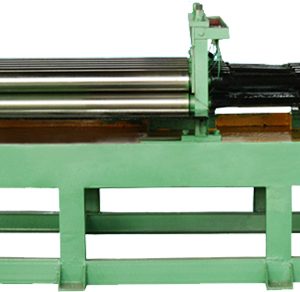
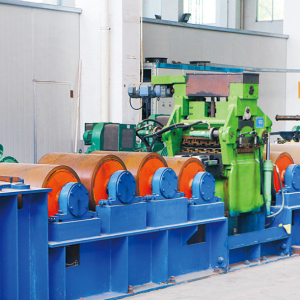
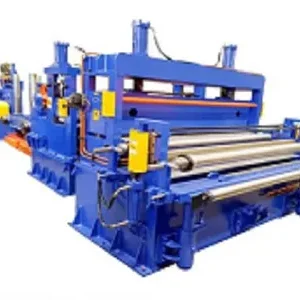
A complete tension leveling line comprises multiple precision-engineered components working in perfect synchronization:
- Hydraulic Uncoiling System: Provides controlled strip feeding with variable tension management
- Precision Shearing Mechanism: Ensures clean head-end preparation for threading operations
- Multi-stage Roller Assembly: Features precisely aligned S-rolls before and after the leveling section
- Cleaning and Brushing Units: Removes contaminants that could affect surface quality
- Core Tension Leveling Unit: The heart of the system, featuring 2-roll or 4-roll configuration options
- Anti-wrinkle Mechanisms: Prevents material distortion during high-speed processing
- Precision Tension-controlled Recoiling: Ensures perfect coil formation with consistent tension throughout
- Automated Hydraulic and Lubrication Systems: Maintains optimal operating conditions for all moving components
HANI engineers have pioneered innovations in hydraulic APC (Automatic Position Control) systems that maintain consistent roll gap positioning despite varying loads—a critical factor in achieving uniform elongation across the entire strip width during tension leveling operations.
Technical Specifications and Performance Parameters
The following table details key specifications for industrial-grade tension leveling equipment processing various steel grades:
| Technical Parameter | 650 Type | 750 Type | 850 Type | 1000 Type |
|---|---|---|---|---|
| Compatible Materials | Carbon steel & low-alloy steel | Carbon steel & low-alloy steel | Carbon steel & low-alloy steel | Carbon steel & low-alloy steel |
| Material Thickness Range (mm) | 0.16-1.5 | 0.3-1.5 | 0.3-1.5 | 0.3-1.5 |
| Material Width Capacity (mm) | 550 | 650 | 750 | 900 |
| Adjustable Elongation Range (%) | 0.2-3.0 | 0.2-3.0 | 0.2-3.0 | 0.2-3.0 |
| Processing Speed (m/min) | 180-300 | 180-300 | 180-400 | 240-600 |
| Leveler Configuration | 2-roll or 4-roll | 2-roll or 4-roll | 2-roll or 4-roll | 2-roll or 4-roll |
| Maximum Rolling Force (kN) | 1450 | 1700 | 2000 | 2500 |
| Drive Mechanism | Work roll transmission | Work roll transmission | Work roll transmission | Work roll transmission |
| Hydraulic System Pressure (MPa) | 10 | 10 | 10 | 10 |
| Main Motor Type | DC/Z4 series | DC/Z4 series | DC/Z4 series | DC/Z4 series |
Material Science Considerations in Tension Leveling Steel Processing
The metallurgical transformations occurring during tension leveling steel processing are complex and require precise control parameters. When cold-rolled steel strips undergo annealing, recrystallization creates new strain-free grains. However, the interaction between interstitial carbon atoms and dislocations often creates the yield point phenomenon that tension leveling must address.
Research published in the Journal of Materials Processing Technology demonstrates that optimal tension leveling parameters vary significantly based on:
- Carbon content (higher carbon requires greater elongation)
- Annealing temperature and cooling rate history
- Grain size distribution (finer grains may require less elongation)
- Surface roughness requirements for end applications
For deep-drawing applications, elongation settings of 0.5-1.0% typically eliminate yield point elongation while preserving excellent formability. For structural applications requiring higher yield strength, elongation settings of 1.5-2.5% can effectively increase yield strength through strain hardening while maintaining adequate ductility.
Critical to successful tension leveling steel processing is maintaining consistent elongation across the entire strip width. Edge wave and center buckle defects occur when elongation varies across the width—a problem addressed through precision roll crown design and sophisticated edge control systems in modern equipment.
Production Efficiency and Quality Metrics
Implementing advanced tension leveling systems delivers measurable improvements in production metrics:
- Yield Improvement: Reducing scrap from stretcher strain defects by 70-90%
- Processing Speed: Modern systems achieve throughput rates exceeding 600 m/min for suitable materials
- Surface Quality: Achieving surface roughness (Ra) values between 0.8-2.5 μm, depending on application requirements
- Flatness Control: Achieving I-Unit flatness measurements below 5 I-Units (where 1 I-Unit = 0.001 inch deviation per inch width)
- Energy Efficiency: Advanced drive systems reduce energy consumption by 15-25% compared to conventional designs
The economic impact of proper tension leveling implementation extends beyond immediate quality improvements. Manufacturers report reduced die wear in stamping operations, fewer rejection incidents in painting processes, and enhanced customer satisfaction due to consistent material behavior during fabrication.
Advanced Control Systems and Automation
Modern tension leveling equipment incorporates sophisticated control architectures that monitor and adjust more than 200 process parameters in real-time. These systems utilize:
- Closed-loop Tension Control: Maintains precise strip tension despite speed variations
- Adaptive Elongation Algorithms: Automatically adjust elongation based on material feedback
- Roll Force Monitoring: Detects minor variations indicating potential quality issues
- Flatness Prediction Models: Uses mathematical models to predict and prevent flatness defects
- Data Analytics Integration: Collects process data for continuous improvement initiatives
The hydraulic APC systems in premium tension leveling equipment provide positioning accuracy within ±0.01mm—critical for maintaining consistent elongation across the entire production run. This precision directly translates to consistent mechanical properties in the finished tension leveling steel products.
Maintenance and Operational Best Practices
Maximizing the performance and lifespan of tension leveling equipment requires adherence to strict maintenance protocols:
- Roll Surface Management: Implement scheduled roll grinding programs to maintain optimal surface finish and profile
- Bearing Lubrication Systems: Maintain proper lubrication of all roll bearings to prevent thermal expansion issues
- Hydraulic Fluid Management: Implement strict fluid cleanliness protocols (ISO 16/14/11 or better)
- Sensor Calibration Schedule: Calibrate load cells, encoders, and position sensors quarterly
- Drive System Maintenance: Conduct preventative maintenance on motor drives according to manufacturer specifications
Experienced operators understand that proper threading procedures significantly impact equipment longevity. Modern tension leveling systems incorporate semi-automatic threading sequences that minimize operator error and reduce threading time by up to 65% compared to manual procedures.
Case Study: Automotive Grade Steel Processing
A major European automotive supplier recently upgraded their tension leveling equipment to handle advanced high-strength steel grades. The project involved processing dual-phase steel (DP600) with thicknesses from 0.7-1.8mm at speeds exceeding 300 m/min.
Challenges:
- Eliminating yield point elongation without compromising formability
- Maintaining consistent surface roughness for subsequent painting operations
- Achieving flatness tolerances below 3 I-Units for laser cutting operations
Solution: Implementation of a 4-roll tension leveling system with:
- Precision hydraulic APC control system
- Variable elongation capability (0.3-2.8%)
- Automated roll bending compensation
- Real-time flatness monitoring and feedback
Results:
- Complete elimination of Lüders bands in formed parts
- 92% reduction in customer quality complaints
- 15% increase in throughput compared to previous equipment
- ROI achieved within 14 months through scrap reduction and productivity gains
This case demonstrates how proper tension leveling implementation directly impacts bottom-line results while ensuring product quality meets the most demanding specifications.
Comparative Analysis: 2-Roll vs. 4-Roll Tension Leveling Systems
| Feature | 2-Roll System | 4-Roll System |
|---|---|---|
| Initial Investment | 20-30% lower | Higher capital investment |
| Operating Costs | 15% lower maintenance costs | Higher maintenance requirements |
| Thickness Range | Limited to medium/heavy gauges | Excellent for thin to medium gauges |
| Surface Finish Capability | Moderate surface enhancement | Superior surface quality improvement |
| Flatness Control | Good for simple flatness issues | Excellent for complex shape defects |
| Elongation Precision | ±0.15% typical | ±0.05% typical |
| Energy Consumption | 10-15% lower | Higher energy requirements |
| Maintenance Complexity | Simpler maintenance procedures | Requires specialized technical support |
The choice between 2-roll and 4-roll tension leveling configurations depends on specific application requirements. Processing thin-gauge, high-value automotive exposed panels typically justifies the investment in 4-roll technology, while structural components may perform adequately with more economical 2-roll systems.
Environmental Considerations and Sustainability
Modern tension leveling equipment incorporates numerous features that support sustainability goals:
- Energy Recovery Systems: Capturing and reusing energy during deceleration phases
- Eco-friendly Hydraulic Fluids: Biodegradable formulations reducing environmental impact
- Reduced Water Consumption: Closed-loop cooling systems minimizing water usage
- Noise Reduction Technologies: Acoustic enclosures reducing operational noise by 15-20 dB
- Long-life Components: Extended wear life reducing replacement frequency and waste generation
The most significant environmental benefit of advanced tension leveling technology is material yield improvement. By eliminating stretcher strain defects and improving flatness consistency, manufacturers reduce scrap generation by significant percentages—directly supporting circular economy initiatives.
Future Developments in Tension Leveling Technology
Industry research points to several emerging innovations in tension leveling systems:
- AI-Driven Process Optimization: Machine learning algorithms predicting optimal settings based on material certificates and historical data
- Digital Twin Integration: Virtual replicas of physical systems enabling predictive maintenance and process simulation
- Adaptive Roll Contouring: Real-time roll shape adjustment compensating for thermal expansion and wear
- Hybrid Drive Systems: Combining hydraulic and electric actuators for optimal response characteristics
- Nanoscale Surface Engineering: Roll surface treatments improving friction characteristics and extending service life
These advancements promise to further enhance the precision and efficiency of tension leveling steel processing, particularly for emerging advanced high-strength steel grades with demanding processing requirements.
Frequently Asked Questions (FAQ)
Q: What is the difference between tension leveling and roller leveling? A: Tension leveling combines controlled tensile forces with bending-unbending cycles, while roller leveling relies solely on bending deformation. Tension leveling produces more consistent mechanical properties throughout the material cross-section and better eliminates yield point elongation phenomena.
Q: What elongation percentage is typically required for automotive exposed panels? A: For automotive exposed panels requiring Class A surface finish, elongation settings typically range from 0.5% to 0.8%—sufficient to eliminate yield point elongation while preserving excellent formability characteristics.
Q: Can tension leveling improve the mechanical properties of annealed steel? A: Yes, tension leveling can effectively increase yield strength through controlled strain hardening while maintaining adequate ductility. This property modification is particularly valuable for structural applications requiring specific strength-ductility combinations.
Q: How often should tension leveling rolls be reground? A: Roll regrinding frequency depends on material processed and production volume. For typical carbon steel applications, work rolls require regrinding every 500-800 tons of processed material, while backup rolls may last 2,000-3,000 tons between regrinds.
Q: What is the maximum speed achievable in modern tension leveling lines? A: For thin-gauge materials (0.3-0.8mm), modern tension leveling lines achieve speeds exceeding 600 m/min. Heavier gauges (1.2-2.0mm) typically run at 80-150 m/min depending on material grade and elongation requirements.
Q: How does tension leveling affect surface roughness of steel strips? A: Tension leveling steel processing can either increase or decrease surface roughness depending on roll surface finish and applied pressure. For automotive applications requiring specific roughness for paint adhesion (typically Ra 1.0-1.8μm), specialized work roll finishes produce controlled surface textures.
Q: What maintenance practices maximize tension leveling equipment lifespan? A: Implementing a comprehensive preventative maintenance program focusing on hydraulic system cleanliness, bearing lubrication, roll surface management, and drive system calibration significantly extends equipment life. Daily visual inspections combined with quarterly comprehensive maintenance typically yield optimal results.
Q: Can tension leveling equipment process coated steel products? A: Yes, modern tension leveling systems effectively process various coated products including galvanized, galvannealed, and aluminized steel. Special roll materials and surface treatments prevent coating damage during processing.
Conclusion: The Strategic Value of Precision Tension Leveling
In today’s competitive metal processing industry, tension leveling represents far more than a simple finishing operation—it’s a strategic capability that directly impacts product quality, customer satisfaction, and bottom-line profitability. The precise control over mechanical properties and flatness characteristics delivered by advanced tension leveling steel processing enables manufacturers to command premium pricing and secure long-term customer relationships.
Manufacturers investing in state-of-the-art tension leveling technology benefit from reduced scrap rates, enhanced production flexibility, and the ability to process increasingly demanding advanced steel grades. These systems pay dividends through consistent product quality that meets the most stringent automotive, appliance, and construction industry requirements.
As material science continues to advance with new steel grades offering improved strength-to-weight ratios, the role of precision tension leveling becomes increasingly critical. Only through proper elongation control and stress management can these advanced materials deliver their promised performance in end applications.
With proper implementation and maintenance, modern tension leveling equipment provides reliable service for decades, making it a sound strategic investment for metal processors committed to quality leadership and operational excellence in an increasingly competitive global marketplace.
HANI is one of China’s leading professional cold rolling mill manufacturers, providing complete cold rolling systems to steel companies worldwide. HANI focuses on designing and manufacturing integrated cold rolling solutions that meet the industry’s highest standards of precision, efficiency, and durability. Our engineering expertise lies in providing turnkey cold rolling production lines to optimize the performance of modern steel manufacturing plants.