

HANI Tension Levelers
Brand name: HANI
Packing Details : Wooden box with fumigation or Wooden Fram or Steel Frame
Delivery Details: 30~60days or Based on the quantity
Shipping: Sea freight、Land freight、Air freight
HANI focuses on cold rolling mill equipment technology, safeguarding your production.
Product Details
In the realm of metal processing, achieving optimal flatness in strip and sheet materials is critical for downstream applications such as automotive body panels, precision electronics, and high-end packaging. Tension levelers, a cornerstone of modern cold rolling lines, combine tension and bending forces to eliminate shape defects like edge waves, center buckles, and camber. This article delves into their functionality, production line integration, key parameters, and advanced optimization techniques.
What is a Tension Leveler?
A tension leveler is a specialized machine designed to improve the flatness of metal strips (steel, aluminum, copper) by subjecting them to controlled tension and bending cycles. Unlike traditional multi-roll levelers, which rely solely on compression, tension levelers induce plastic deformation across the entire thickness of the material, achieving superior flatness and stress uniformity. This process is particularly effective for high-strength materials with yield strengths exceeding 1,000 MPa, such as advanced high-strength steels (AHSS) used in automotive lightweighting.
Key Functions
- Shape Correction: Eliminates longitudinal waves, transverse bends, and quarter buckles.
- Stress Relief: Redistributes internal residual stresses, minimizing springback during forming.
- Surface Preparation: Enhances surface quality for coating or painting processes.
- Scale Breaking: In pickling lines, breaks oxide scales to improve acid penetration efficiency.
Production Line Integration
A typical tension leveling line consists of the following stages:
| Stage | Function |
|---|---|
| Uncoiler | Feeds the coil into the line. |
| Pinch Rolls | Guides the strip and maintains tension stability. |
| Hydraulic Shear | Cuts the strip to length for welding. |
| Welder | Joins the end of one coil to the start of the next for continuous processing. |
| Entry S-Rolls | Establishes initial tension and guides the strip into the leveler. |
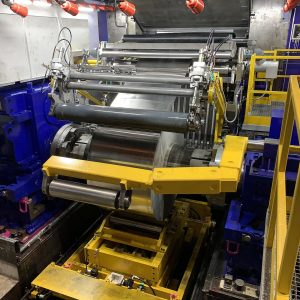
| Tension Leveler | Core unit for flatness correction via tension and bending. |
| Exit S-Rolls | Maintains tension post-leveling and feeds the strip to downstream units. |
| Coating Machine | Applies anti-rust oil or other coatings (optional). |
| Recoiler | Winds the processed strip into a finished coil. |
Key Process Parameters
The performance of a tension leveler hinges on precise control of the following parameters:
| Parameter | Range | Impact |
|---|---|---|
| Strip Width | 350–1,300 mm | Wider strips require larger roll diameters and higher tension capacity. |
| Strip Thickness | 0.2–1.2 mm | Thicker strips demand stronger bending forces and higher roll rigidity. |
| Elongation Rate | 0.5–3% | Higher elongation improves flatness but risks edge cracking in brittle materials. |
| Tension Force | Up to 1,100 kN | Critical for high-strength steels; insufficient tension leads to incomplete correction. |
| Roll Diameter | 10–40 mm (work rolls) | Smaller rolls enable finer bending cycles for ultra-thin materials. |
| Roll Quantity | 11–29 rolls (precision models) | More rolls distribute deformation evenly, reducing residual stress. |
Advanced Optimization Techniques
To maximize efficiency and product quality, manufacturers employ cutting-edge methods:
1. Particle Swarm Optimization (PSO)
A study published in Iron & Steel (2021) demonstrated the use of PSO to optimize tension leveler parameters for cold-rolled strips. By modeling elongation as a function of tension, roll gap, and bending radius, the algorithm minimized errors between predicted and actual flatness metrics. Industrial trials showed a 20% reduction in shape defects and a 15% increase in line speed.
2. Neural Network Control Models
Researchers at Heavy Machinery Institute developed a BP neural network to preset parameters based on material type, thickness, and desired flatness. The model, trained on historical production data, reduced setup time by 40% and achieved 98% accuracy in flatness predictions.
3. Closed-Loop Feedback Systems
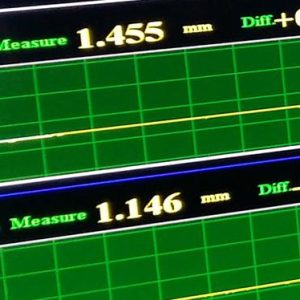
Modern tension levelers integrate laser or contact-based scanners at the exit to measure real-time flatness. The system adjusts roll pressure and tension dynamically, ensuring consistency even with varying input conditions. For example, SMS Group’s SB-80-V1050 model achieves ≤0.3 mm/m flatness for 2 mm stainless steel sheets.
Applications Across Industries
- Automotive: Produces flat outer panels for paint-free body-in-white (BIW) assembly.
- Electronics: Supplies ultra-flat copper foils for lithium-ion battery current collectors.
- Packaging: Ensures defect-free aluminum strips for beverage can bodies.
- Construction: Provides high-strength steel plates for earthquake-resistant buildings.
Future Trends
- Digital Twins: Simulating the leveling process virtually to reduce trial-and-error setups.
- AI-Driven Adaptation: Machine vision systems that detect micro-defects and adjust parameters in real time.
- Hybrid Lines: Combining tension leveling with deburring, pre-coating, or laser marking for one-stop processing.
Conclusion
Tension levelers are indispensable tools for achieving micro-level flatness in metal strips, enabling manufacturers to meet stringent quality standards in high-value applications. By leveraging advanced control algorithms and real-time feedback, these machines continue to evolve, pushing the boundaries of precision and efficiency in metal processing.
For businesses seeking to upgrade their flatness correction capabilities, investing in a custom-engineered tension leveler tailored to specific material grades and production volumes is a strategic move toward sustainable competitiveness.
HANI is one of China’s leading professional cold rolling mill manufacturers, providing complete cold rolling systems to steel companies worldwide. HANI focuses on designing and manufacturing integrated cold rolling solutions that meet the industry’s highest standards of precision, efficiency, and durability. Our engineering expertise lies in providing turnkey cold rolling production lines to optimize the performance of modern steel manufacturing plants.