Introduction to Application Effects of Cold Rolling Mills
The manufacturing landscape is built upon precision, strength, and quality. Central to achieving these attributes in flat-rolled metal products is the process of cold rolling. A cold rolling mill is not merely a piece of heavy machinery; it is a sophisticated system designed to transform metal strips, enhancing their mechanical properties, refining their surface finish, and achieving unparalleled dimensional accuracy. This comprehensive article delves into the intricate application effects of the cold rolling mill, exploring the key parameters, technological advancements, and practical outcomes that define its critical role in modern industry. From automotive body panels to beverage cans and high-precision electronic components, the influence of cold rolling is ubiquitous.
1. Fundamental Principles and Core Objectives of Cold Rolling
Cold rolling is a metal forming process that occurs below the material’s recrystallization temperature, typically at room temperature. Unlike hot rolling, which prioritizes large-scale reduction and shaping, cold rolling is a finishing process focused on refinement. The primary objectives and their resulting effects are:
- Enhancement of Mechanical Properties: The process induces work hardening (or strain hardening). As the metal is plastically deformed, dislocations are generated and move within the crystal structure, impeding further dislocation movement. This significantly increases the material’s hardness, yield strength, and tensile strength, albeit at the cost of reduced ductility.
- Superior Dimensional Tolerance: Cold rolling allows for the production of strips with exceptionally tight thickness tolerances. Modern cold rolling mill systems, equipped with Automatic Gauge Control (AGC), can maintain thickness variations within a few micrometers over thousands of meters of coil.
- Improved Surface Finish: The smooth, highly polished surface of the work rolls is imparted onto the metal strip. This results in a clean, bright, and smooth surface (measured by a low Ra, or Roughness average value) that is often a final requirement or ideal for subsequent coating or painting processes.
2. Critical Operational Parameters and Their Application Effects
The final quality of a cold-rolled product is a direct consequence of the precise control over several key operational parameters. Understanding their interplay is crucial for any production environment.
2.1. Rolling Reduction (Pass Reduction)
Reduction is the percentage decrease in thickness achieved in a single pass through the rolls. It is perhaps the most fundamental parameter influencing the material’s final state.
- Effect on Microstructure: Higher reduction elongates the grain structure in the rolling direction, increasing the density of dislocations and leading to significant work hardening.
- Effect on Rolling Force: A greater reduction requires a higher rolling force, which in turn increases the elastic deformation of the mill stand (mill spring) and rolls. This must be compensated for by the AGC system.
- Pass Schedule Design: In a multi-pass or tandem cold rolling mill, the “pass schedule” (the reduction at each stand) is meticulously designed to balance productivity, shape control, and the final desired mechanical properties. Early passes typically have higher reductions, while final passes are lighter to fine-tune thickness and flatness.
2.2. Rolling Force and Roll Gap
The rolling force is the compressive force exerted by the rolls onto the strip. It is a reaction to the material’s resistance to deformation. The roll gap is the minimum distance between the work rolls. These two are intrinsically linked.
The actual exit thickness (h_out) is determined by the unloaded roll gap setting (S₀) plus the elastic stretch of the mill housing (mill spring), which is proportional to the rolling force (F). This is often simplified by the Gage Meter Equation:
h_out = S₀ + (F / M)
Where ‘M’ is the mill modulus (stiffness). This relationship highlights a critical effect: any variation in incoming thickness, hardness, or temperature will change the required rolling force ‘F’, which in turn changes the mill stretch and thus the exit thickness. This is precisely why Automatic Gauge Control (AGC) systems are essential; they rapidly adjust the roll gap (S₀) to counteract changes in ‘F’ and maintain a constant h_out.
Furthermore, high rolling forces cause roll bending and flattening. This leads to the strip being slightly thicker in the center than at the edges, a phenomenon known as “strip crown.” Advanced mills use work roll bending and other techniques to counteract this and control the strip’s transverse profile.
2.3. Strip Tension (Front and Back)
Tension applied to the strip as it enters (back tension) and exits (front tension) the roll gap has a profound effect on the process.
- Reduction of Rolling Force: Applying tension effectively “pre-stresses” the material, reducing its apparent compressive yield strength. This lowers the required rolling force for a given reduction, which in turn reduces mill power consumption and roll wear.
- Flatness Control: Tension is a primary tool for ensuring strip flatness. It pulls the strip taut, removing minor shape defects like buckles or waves. In a tandem cold rolling mill, the inter-stand tension is precisely controlled to maintain stability and flatness throughout the line.
- Tracking and Stability: Proper tension ensures the strip tracks correctly through the center of the mill, preventing costly wrecks and edge damage.
2.4. Rolling Lubricant and Cooling
The role of rolling oil (lubricant) is multifaceted and critical, especially at high rolling speeds.
- Friction Reduction: It forms a thin film between the roll and strip, reducing friction. This lowers the rolling force and energy consumption.
- Cooling: The immense pressure and deformation generate significant heat. The lubricant acts as a coolant, carrying heat away from the rolls and strip. This prevents thermal expansion of the rolls (thermal crown) which would negatively affect the strip profile.
- Surface Quality: A clean, well-maintained lubricant prevents surface defects like staining, pickup (adhesion of strip material to the roll), and scratches, ensuring a pristine surface finish.
3. Types of Cold Rolling Mills and Their Application-Specific Effects
The configuration of a cold rolling mill is chosen based on the desired product, material, and production volume. Each type offers distinct advantages and application effects.
| Mill Type | Configuration | Primary Application & Effects | Key Advantages |
|---|---|---|---|
| Single-Stand Reversing Mill | One mill stand. The coil is passed back and forth through the rolls multiple times. | Specialty alloys, smaller production runs, diverse product mixes. Effect: High flexibility, but lower throughput. Temperature changes between passes can affect consistency. | Lower capital cost, operational flexibility, smaller footprint. |
| Tandem Mill | Multiple (3-6) mill stands in a continuous line. The strip passes through each stand only once. | Mass production of carbon steel for automotive, appliance, and tinplate. Effect: Extremely high productivity and stable rolling conditions. Consistent quality. | High speed, high volume, excellent process stability, superior gauge and flatness control. |
| 4-High Mill | Two small-diameter work rolls supported by two large-diameter backup rolls. | The workhorse for most cold rolling applications. Effect: Backup rolls prevent work roll bending, allowing for higher forces and wider strips. | Good balance of capability and cost. Widely used and well-understood technology. |
| 6-High (HC/UCM) Mill | Adds two intermediate rolls between the work rolls and backup rolls. | High-quality steel, stainless steel, aluminum. Effect: Intermediate rolls can be shifted axially, providing powerful control over strip edge profile (“edge drop”) and overall flatness. | Superior shape and profile control, ability to roll a wider range of products on a single mill. |
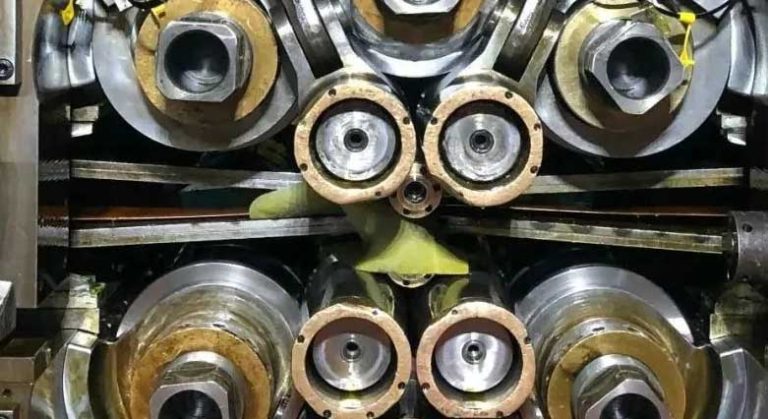
| 20-High (Sendzimir) Mill | A cluster of 20 rolls supporting two extremely small work rolls. | Hard and thin materials like stainless steel foil, silicon steel, and high-strength alloys. Effect: The rigid housing and support allow for massive reductions on very hard materials to ultra-thin gauges. | Extreme mill stiffness, ability to produce ultra-thin and hard strip with excellent precision. |
4. Quantifiable Application Effects: A Practical Example
To illustrate the tangible effects of a cold rolling mill, consider the transformation of a typical low-carbon steel strip (e.g., SAE 1008) from its hot-rolled, annealed state to a full-hard, cold-rolled product.
4.1. Effect on Mechanical Properties
The work hardening induced by cold reduction dramatically alters the material’s strength and ductility. The table below shows typical values for a low-carbon steel strip undergoing various levels of cold reduction.
| Material State (Total Cold Reduction) | Yield Strength (MPa) | Tensile Strength (MPa) | Elongation (%) | Hardness (HRB) |
|---|---|---|---|---|
| Annealed (0%) | ~210 | ~330 | ~40 | ~45 |
| Quarter Hard (~15% Reduction) | ~310 | ~400 | ~20 | ~65 |
| Half Hard (~30% Reduction) | ~410 | ~480 | ~10 | ~78 |
| Full Hard (~50%+ Reduction) | ~590 | ~620 | ~3 | ~90 |
This data clearly shows the trade-off: as strength and hardness increase dramatically, ductility (elongation) plummets. This is a fundamental application effect that engineers must account for when specifying materials for forming operations.
4.2. Effect on Dimensional and Surface Quality
- Thickness Tolerance: A hot-rolled strip might have a thickness tolerance of ±0.20 mm. After processing on a modern cold rolling mill with hydraulic AGC, the same strip can achieve a tolerance of ±0.005 mm. This is a 40-fold improvement in precision.
- Surface Finish (Ra): A pickled hot-rolled band may have a surface roughness of 1.5-3.0 µm Ra. A standard cold-rolled finish is typically 0.3-0.6 µm Ra, and a bright finish for decorative applications can be below 0.1 µm Ra. This smooth surface is essential for high-quality painting and plating.
Conclusion: The Synthesis of Power and Precision
The application effects of a cold rolling mill are a testament to the sophisticated engineering that underpins modern materials science. It is a process that synthesizes immense power—forces measured in thousands of tons—with micrometer-level precision. By carefully manipulating parameters like reduction, force, tension, and lubrication, a cold rolling mill does more than just make metal thinner; it fundamentally re-engineers the material, imparting desirable properties of strength, finish, and form. The choice of mill configuration, from a flexible reversing mill to a high-productivity tandem line, further tailors these effects to meet the specific demands of a vast array of end-use applications. As technology continues to evolve with advanced sensors, predictive AI models, and novel lubrication systems, the capabilities and application effects of the cold rolling process will only become more refined, continuing to push the boundaries of what is possible in material manufacturing.