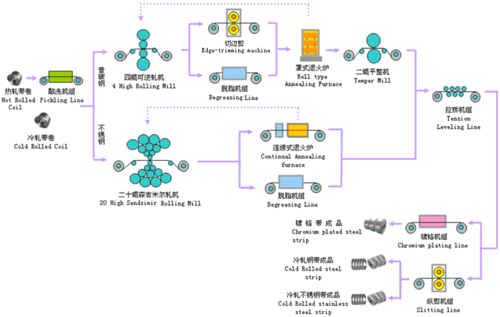
Composition and Characteristics of 6 Hi Cold Rolling Mill
In the modern metal processing industry, achieving high precision, superior surface finish, and consistent flatness in cold-rolled strip products is critical for downstream applications such as automotive body panels, electrical steel cores, and high-end packaging materials. Among various rolling mill configurations, the 6 Hi cold rolling mill has emerged as a preferred solution for demanding applications due to its enhanced rigidity, advanced shape control capabilities, and operational flexibility. This article provides a comprehensive technical overview of the composition, working principles, key characteristics, performance parameters, and industrial relevance of the 6 Hi cold rolling mill.
Structural Composition of a 6 Hi Cold Rolling Mill
A 6 Hi cold rolling mill consists of six rolls arranged symmetrically in three pairs: two work rolls, two intermediate rolls, and two backup (support) rolls. Unlike conventional 4 Hi mills, the inclusion of intermediate rolls significantly improves roll stack stiffness and enables dynamic shape control during rolling. Below is a detailed breakdown of each component:
1. Work Rolls
The work rolls are the smallest in diameter and make direct contact with the strip material. Typically manufactured from high-carbon chromium alloy steel (e.g., Cr5 or Cr8), they undergo precision grinding and surface hardening (HRC 60–65) to ensure wear resistance and dimensional stability. Key features include:
- Diameter range: 300–550 mm (depending on product width and reduction ratio)
- Surface roughness: Ra ≤ 0.05 μm for bright finish applications
- Crown profile: Custom-ground (e.g., 0–100 μm) to compensate for thermal and mechanical deflection
2. Intermediate Rolls
This is the defining feature of the 6 Hi configuration. Positioned between the work rolls and backup rolls, intermediate rolls serve multiple functions:
- Provide additional support to reduce work roll bending under high rolling loads
- Enable axial shifting (typically ±100 to ±200 mm) to dynamically adjust the effective roll gap profile
- Facilitate edge drop control and flatness correction via roll bending or窜动 (axial movement)
Intermediate rolls are usually made from forged alloy steel with surface hardness around HRC 55–60. Their diameter typically ranges from 450 mm to 700 mm.
3. Backup Rolls
These large-diameter rolls (700–1200 mm) absorb the majority of the rolling force and prevent deflection of the entire roll stack. Constructed from high-strength forged steel (e.g., 60CrMoV), they are supported by robust chocks and housed in massive mill housings. Backup rolls often incorporate oil film bearings or tapered roller bearings for high-load capacity and minimal friction.
4. Drive System
Modern 6 Hi mills employ individual AC vector-controlled motors for each work roll, enabling precise speed synchronization and tension control. Typical specifications include:
- Motor power: 1,000–5,000 kW per stand (for single-stand reversible mills)
- Speed range: 0–1,200 m/min (depending on product and mill design)
- Dynamic response time: < 50 ms for torque adjustments
5. Hydraulic and Control Systems
Advanced hydraulic systems provide:
- Rapid and precise roll gap adjustment (via hydraulic screwdowns)
- Work roll bending (WRB) and intermediate roll bending (IRB) forces up to 2,000 kN
- Intermediate roll窜动 (axial shifting) with position accuracy of ±0.1 mm
Integrated with real-time flatness measurement (e.g., using X-ray or optical sensors), these systems enable closed-loop shape control.
6. Lubrication and Cooling System
A high-pressure emulsion system delivers lubricant-coolant mixture (typically 3–8% oil in water) directly to the roll bite. This reduces friction, controls temperature rise (<50°C at exit), and minimizes surface defects like scratches or pick-up.
Key Technical Characteristics and Advantages
The 6 Hi cold rolling mill offers several distinct advantages over 4 Hi and 2 Hi configurations, particularly in high-precision applications:
Enhanced Strip Flatness and Profile Control
The ability to axially shift intermediate rolls allows operators to tailor the roll gap shape dynamically. For example, shifting intermediate rolls outward reduces edge thinning (edge drop), while inward shifting compensates for center buckle. Combined with work roll bending, this provides multi-zone flatness correction unmatched by 4 Hi mills.
Higher Reduction Capability
Due to increased stack rigidity (typically 20–30% higher than 4 Hi mills), 6 Hi mills can achieve greater single-pass reductions—up to 60% for mild steel—without compromising strip quality or roll life.
Extended Work Roll Life
By distributing load through intermediate rolls, work roll deflection is minimized, reducing localized wear and thermal cracking. This extends work roll campaign life by 25–40%, lowering maintenance costs and downtime.
Broad Material Compatibility
6 Hi mills efficiently process a wide range of materials, including:
- Low-carbon steel (e.g., DC01–DC06)
- High-strength low-alloy (HSLA) steels
- Stainless steels (e.g., 304, 430)
- Non-ferrous alloys (copper, brass, aluminum up to 3 mm thick)
This versatility makes them ideal for job shops and specialty producers.
Superior Surface Finish
Smaller work roll diameters and optimized lubrication yield excellent surface quality—critical for exposed automotive or appliance panels. Typical surface roughness (Ra) values range from 0.1 to 0.8 μm, depending on roll texture and rolling conditions.
Typical Operating Parameters and Performance Data
The following table summarizes representative technical specifications for industrial-grade 6 Hi cold rolling mills used in steel and non-ferrous strip production:
| Parameter | Steel Rolling (Reversible) | Stainless Steel | Aluminum/Copper |
|---|---|---|---|
| Max. Strip Width | 1,650 mm | 1,550 mm | 1,800 mm |
| Entry Thickness | 1.0–6.0 mm | 1.2–5.0 mm | 0.5–4.0 mm |
| Exit Thickness | 0.15–3.0 mm | 0.2–2.5 mm | 0.05–2.0 mm |
| Max. Rolling Force | 25,000 kN | 22,000 kN | 12,000 kN |
| Work Roll Diameter | 400–500 mm | 420–520 mm | 300–450 mm |
| Intermediate Roll Diameter | 550–650 mm | 580–680 mm | 480–600 mm |
| Backup Roll Diameter | 1,000–1,200 mm | 1,050–1,250 mm | 900–1,100 mm |
| Max. Speed | 1,000 m/min | 800 m/min | 1,200 m/min |
| Thickness Tolerance | ±3–5 μm | ±4–6 μm | ±2–4 μm |
| Flatness Tolerance | < 10 I-Units | < 12 I-Units | < 8 I-Units |
Note: I-Unit (International Unit) is a standard metric for flatness deviation, where 1 I-Unit = 10⁻⁵ strain difference across the strip width.
Industrial Applications and Use Cases
6 Hi cold rolling mills are widely deployed in sectors requiring stringent dimensional and surface quality control:
- Automotive Industry: Production of ultra-high-strength steel (UHSS) for structural components, where flatness affects stamping performance.
- Electrical Steel Manufacturing: Rolling of grain-oriented (GOES) and non-oriented (NGOES) electrical steel with tight thickness tolerances to minimize core losses.
- Appliance and Construction**: Bright-annealed stainless steel coils for refrigerators, elevators, and architectural cladding.
- Specialty Metal Producers: Custom rolling of copper alloys for heat exchangers or aluminum foils for capacitors.
Notably, many modern 6 Hi mills are integrated into tandem lines (e.g., 5-stand 6 Hi tandem cold mills) for high-volume production, though single-stand reversible configurations remain popular for flexible batch processing.
Comparison with Other Mill Types
Why Choose 6 Hi Over 4 Hi?
While 4 Hi mills are simpler and lower-cost, they lack the dynamic shape control of 6 Hi systems. For products requiring flatness below 15 I-Units or thickness tolerance tighter than ±10 μm, 6 Hi mills offer superior performance—especially for wide strips (>1,200 mm) or hard materials like stainless steel.
Compared to 20 Hi Sendzimir mills, 6 Hi mills have lower capital cost and easier maintenance but cannot achieve the extreme reductions (<0.05 mm) possible with cluster mills. Thus, the 6 Hi strikes an optimal balance for medium-to-high precision applications.
Maintenance and Operational Best Practices
To maximize uptime and product quality, operators should adhere to the following practices:
- Roll Inspection**: Monitor work roll surface for spalling, thermal cracks, or uneven wear after every 200–300 tons rolled.
- Lubricant Management**: Maintain emulsion concentration within ±0.2% and filter particles >10 μm to prevent surface scratches.
- Hydraulic System Care**: Replace servo valves every 18–24 months and monitor pressure ripple to avoid chatter marks.
- Calibration**: Recalibrate flatness sensors and roll gap transducers quarterly using certified reference strips.
Future Trends and Technological Integration
Emerging innovations are further enhancing 6 Hi mill capabilities:
- Digital Twins**: Real-time simulation models predict roll wear and optimize pass schedules.
- AI-Based Flatness Control**: Machine learning algorithms analyze historical data to auto-tune bending forces and窜动 positions.
- Energy Recovery Systems**: Regenerative drives capture braking energy during deceleration, reducing power consumption by 8–12%.
As demand grows for lightweight, high-strength materials in EVs and renewable energy systems, the 6 Hi cold rolling mill will continue to play a pivotal role in advanced metal forming.
Conclusion
The 6 Hi cold rolling mill represents a mature yet continuously evolving technology that bridges the gap between cost-effectiveness and high-performance rolling. Its unique six-roll architecture—featuring axially movable intermediate rolls—delivers exceptional control over thickness, flatness, and surface quality across a broad spectrum of metallic materials. With robust mechanical design, integration-ready automation, and proven reliability in industrial environments, it remains a cornerstone of modern cold strip production. For manufacturers targeting premium-grade products with stringent tolerances, investing in a well-engineered 6 Hi mill is not just a technical choice—it’s a strategic advantage.