
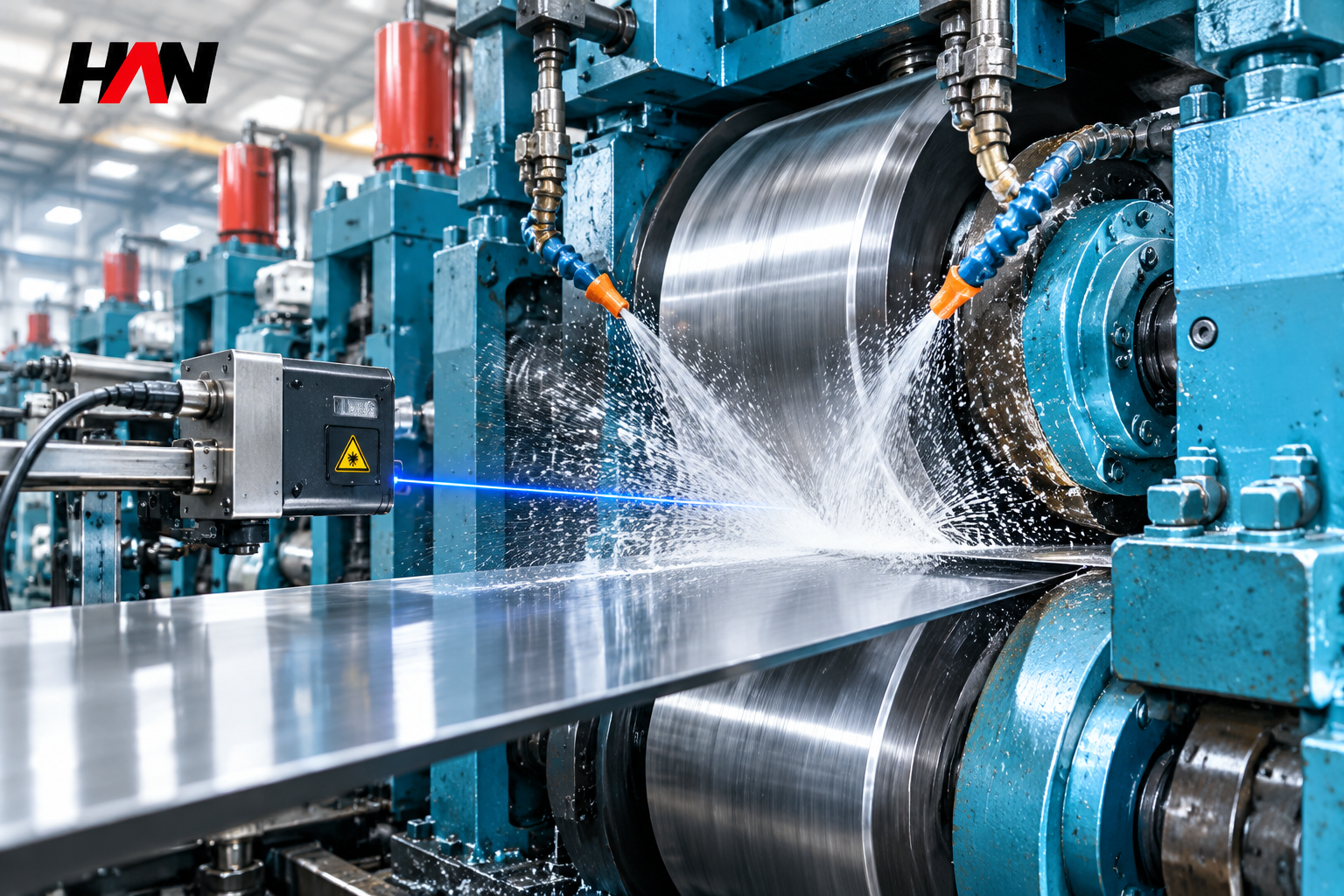
Types of Cold Rolling Processes
Cold rolling of steel plates and strips falls into two categories: single-sheet rolling and coil rolling.
Single-sheet rolling Early single-sheet rolling adopted 2-high mills; nowadays 4-high cold rolling mills are widely used. Based on roll rotation direction, 4-high cold mills are divided into non-reversing and reversing types.
For non-reversing 4-high mills in single-sheet production: steel plates are manually fed into the mill one by one. After the entire stack completes one rolling pass, the stack is transferred by crane to the mill entry for the next pass. The cycle repeats until the target finished dimension is achieved.
For reversing mills, two operating modes are available:
- Mode 1: Each plate is rolled back and forth on the mill until the final dimension is reached, followed by the next plate. Frequent screw-down adjustments are required, yet surface scratching is less likely. This method is widely adopted in practice, especially for heavy and large-size plates.
- Mode 2: All plates in the stack complete one pass first, then return one by one for the second pass. This delivers more consistent dimensional accuracy and saves time on roll reversal and screw-down adjustment, raising mill output. However, scratching between plate surfaces may occur occasionally.
No tension can be applied in single-sheet rolling, so the reduction per pass is generally limited to ≤14%. More rolling passes lead to greater work hardening. Therefore, ultra-thin cold rolled products cannot be produced by this method.
Coil rolling dominates modern cold rolling production, with two basic forms: single-stand coil rolling and multi-stand continuous coil rolling. Coil rolling uses non-reversing and reversing cold mills including 2-high, 4-high, cluster 8-high, 12-high and 20-high mills.
Single-stand non-reversing cold mills mainly include 2-high and 4-high types (Fig.1-1). Hundreds of such mills are in service in China, with barrel length 100–600 mm and roll diameter 100–300 mm. Most are equipped with uncoilers and recoilers. They are mainly used for narrow strips below 600 mm width or skin-pass rolling of coiled narrow strips, at rolling speeds of 1.2–2.0 m/s.
Single-stand reversing cold mills cover 4-high mills and multi-high mills (cluster 8-high, 12-high, 20-high mills). Most adopt work roll drive to reduce total rolling force and power consumption, enabling rolling of thinner gauges. Table 1-1 lists the main technical specifications of a 1200 mm 4-high reversing cold mill.
Compared with single-stand reversing cold mills, multi-stand continuous cold mills have the following characteristics: (1) High rolling speed, normally above 25 m/s (max. up to 41 m/s). (2) Premium product quality, satisfying customer requirements on mechanical properties, surface condition, thickness and dimensional tolerance. (3) Rolling reduction is available at both ends of the coil, minimizing crop loss and delivering high metal yield. (4) High output, with annual capacity ranging from several hundred thousand tonnes to over 1 million tonnes. (5) Outstanding performance enabled by hydraulic screw-down systems, integrated automatic control and advanced technologies.
