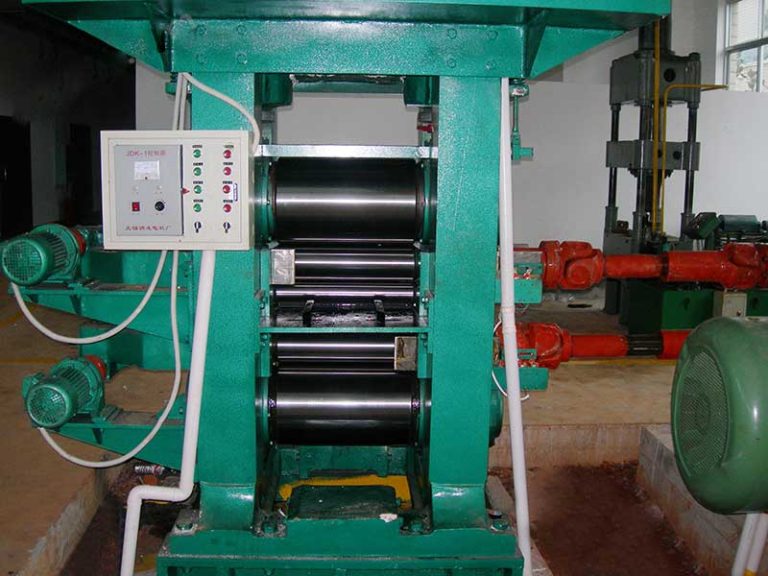
Principles and Characteristics of 4 Hi Cold Rolling Mill
In the modern metallurgical industry, the 4 hi cold rolling mill stands as a cornerstone technology for processing metal strips and coils. Unlike hot rolling, which processes metal above its recrystallization temperature, cold rolling occurs at room temperature, allowing for superior surface finishes, tighter dimensional tolerances, and enhanced mechanical properties. The 4-high configuration (four rolls arranged vertically) is the industry standard for balancing structural rigidity with rolling efficiency.
This article provides a comprehensive technical analysis of the principles, structural characteristics, and production parameters of the 4 hi cold rolling mill. Designed for engineers, plant managers, and procurement specialists, this guide delves into the scientific mechanics of rolling, real-world data application, and the operational advantages that make this equipment indispensable for processing stainless steel, carbon steel, copper, and aluminum alloys.
1. Scientific Principle of the 4 Hi Cold Rolling Mill
The fundamental principle of any rolling mill is plastic deformation. The metal passes between two rotating rolls, and the compressive force reduces the thickness while increasing the length (and slightly the width). However, in a simple 2-hi mill (two rolls only), a significant physical limitation arises: Roll Deflection.
When rolling wide sheets or hard materials, the separating force generated by the metal pushes the rolls apart in the center. In a 2-hi setup, this causes the rolls to bend, resulting in a strip that is thicker in the middle (crown) and thinner at the edges. The 4 hi cold rolling mill solves this physics problem through a specific geometric arrangement:
- Work Rolls (WR): The two smaller rolls in direct contact with the metal. Their smaller diameter reduces the contact area, which lowers the rolling force required and reduces power consumption.
- Backup Rolls (BUR): The two larger rolls located on the outside (top and bottom). They do not touch the metal strip but support the work rolls. Their massive diameter and stiffness prevent the work rolls from bending under high loads.
By transferring the rolling force from the small work rolls to the massive backup rolls, the 4-hi configuration achieves a rigid “beam” effect. This allows for extreme reduction ratios (up to 90% in multiple passes) while maintaining flatness across the strip width.
2. Technical Characteristics and Advantages
High Precision (Micron Level)
Modern 4 hi cold rolling mills utilize Hydraulic Automatic Gauge Control (HAGC). Unlike mechanical screw-downs, hydraulic cylinders can adjust the roll gap in milliseconds. Combined with X-ray thickness gauges, this system maintains output tolerance within ±2μm to ±5μm, essential for automotive and electronic applications.
Superior Surface Quality
The use of small diameter work rolls creates a high-pressure zone that effectively “irons” the surface. Coupled with advanced filtration systems for the rolling oil (coolant), the mill produces a mirror-like finish (2B or BA finish in stainless steel) free from chatter marks.
High Load Capacity
The backup rolls absorb the bending moment. This allows the mill to process high-strength materials such as High-Carbon Steel, Titanium Alloys, and exotic Stainless Steels that would otherwise deform the rolls of a standard mill.
3. Typical Technical Parameters (Reference Data)
To provide production reference value, the following table outlines the specifications for three common configurations of 4 hi cold rolling mills: a narrow strip mill, a medium-width reversible mill, and a wide strip tandem mill. Note that specific parameters can be customized based on the material yield strength.
| Parameter / Model | CRM-450 (Precision) | CRM-850 (Reversible) | CRM-1450 (High Speed) |
|---|---|---|---|
| Strip Width (mm) | 200 – 400 | 450 – 800 | 900 – 1350 |
| Input Thickness (mm) | Max 3.0 | Max 4.5 | Max 6.0 |
| Min Output Thickness (mm) | 0.05 | 0.15 | 0.25 |
| Work Roll Diameter (mm) | Φ120 – Φ140 | Φ260 – Φ280 | Φ380 – Φ410 |
| Backup Roll Diameter (mm) | Φ400 – Φ420 | Φ750 – Φ800 | Φ1100 – Φ1200 |
| Rolling Speed (m/min) | Max 300 | Max 800 | Max 1400 |
| Rolling Force (kN) | 2,500 | 8,000 | 18,000 |
| Main Motor Power (DC/AC) | 400 kW | 1200 kW | 3500 kW |
| Applicable Material | Copper, High-C Steel | Stainless, Silicon Steel | Low Carbon Steel (Auto) |
*Parameters are for reference only and vary by manufacturer design.
4. Structural Composition & Critical Components
A 4 hi cold rolling mill is a complex assembly of mechanical, hydraulic, and electrical systems. Understanding these components is crucial for maintenance and troubleshooting.
1. The Mill Stand (Housing)
The housing is the skeleton of the mill. It is typically a massive, closed-frame casting (often SC450 or SC480 cast steel) designed to withstand the separating force without stretching. Modern mills use “heavy-duty” windows to accommodate the bearing chocks. The rigidity of the housing directly influences the longitudinal gauge accuracy.
2. Roll Assembly and Chocks
Work Rolls: Usually made from forged alloy steel (e.g., 9Cr2Mo or semi-high speed steel) with a hardness of HSD 90-100. They require frequent grinding to maintain surface finish.
Backup Rolls: Made from cast steel or forged steel (e.g., 60CrMoV), usually slightly softer (HSD 65-75) to prevent slipping and improve friction grip with the work roll.
3. Screw-down and AGC System
This system controls the gap between rolls.
- Electro-mechanical Screw-down: Uses large worm gears for coarse adjustment of the roll gap.
- Hydraulic AGC (Automatic Gauge Control): Cylinders located at the bottom (or top) of the stand. They respond to thickness feedback sensors, adjusting pressure up to 50 times per second to compensate for incoming strip hardness variations or speed changes.
4. Coiling and Uncoiling Systems
For reversible 4-hi mills, solid drums (mandrels) with hydraulic expansion segments are used on both sides. High tension is critical in cold rolling to ensure flatness. The coilers must provide constant tension (using current control or load cell feedback) even as the coil diameter changes during the pass.
5. Production Process and Quality Control
Operating a 4 hi cold rolling mill requires strict adherence to process parameters. Here, we analyze the critical factors affecting the final product.
Lubrication and Cooling (Rolling Oil)
Friction in the “roll bite” is necessary for the metal to be pulled through, but excess friction generates heat and defects. A sophisticated emulsion system sprays coolant onto the work rolls and the strip.
Key Checkpoint: The temperature of the emulsion should be controlled between 40°C – 55°C. If the rolls overheat, “thermal crown” occurs, changing the roll shape and causing “quarter buckle” defects in the strip.
Common Rolling Defects and Solutions
| Defect Type | Root Cause | Countermeasure |
|---|---|---|
| Edge Waves | Roll edges are pressing too hard; Roll bending is excessive. | Increase Work Roll Bending force (positive bending); Reduce rolling pressure; Check roll crowning. |
| Center Buckle | Excessive pressure in the center; Insufficient roll crowning. | Decrease roll bending force; Improve coolant flow to center of rolls. |
| Roll Marks | Foreign matter on rolls; Damaged roll surface. | Immediate roll change; Check wiper systems and filtration units. |
| Thickness Variation | AGC system lag; Incoming strip variation too high. | Calibrate X-ray gauges; Reduce speed during acceleration/deceleration. |
6. Industry Applications
The versatility of the 4 hi cold rolling mill makes it the “workhorse” of the metal processing industry.
- Automotive Industry: Production of high-strength low-alloy (HSLA) steels for car bodies, requiring strict thickness tolerance for weight reduction.
- Electrical Appliances: Rolling of stainless steel for refrigerator doors, washing machine drums, and microwave panels where surface finish is paramount.
- Construction Materials: Production of substrate for galvanized or color-coated coils used in roofing and siding.
- Electronics: Precision rolling of copper alloys for lead frames and connectors (often using smaller, specialized 4-hi or 6-hi mills).
7. Future Development and Summary
While the 4 hi cold rolling mill is a mature technology, it continues to evolve. The integration of Industry 4.0 concepts is the current trend. Modern mills are being equipped with AI-driven models that predict “roll wear” and automatically adjust pass schedules to extend roll life and improve quality consistency.
In summary, the 4 hi cold rolling mill balances the conflicting requirements of rolling force and roll deflection. Its ability to provide high reduction rates, excellent flatness, and superior surface finish ensures its place as a critical asset in metal manufacturing. For manufacturers aiming to produce high-value-added metal sheets, investing in a robust, hydraulic AGC-equipped 4-hi mill is a strategic necessity.