Sheet Metal Rolling in Cold Rolling Mills
Sheet metal rolling represents one of the most critical manufacturing processes in modern metallurgical industries. The cold rolling mill process has revolutionized how we produce thin, precise metal sheets with superior surface quality and mechanical properties. This comprehensive guide explores every aspect of cold rolling technology, from fundamental principles to advanced operational parameters.
Understanding the Cold Rolling Mill Process
The cold rolling mill process involves reducing the thickness of metal sheets at temperatures below their recrystallization point, typically at room temperature. Unlike hot rolling, which occurs above 1000°C for steel, cold rolling operates between 20°C and 200°C, depending on the material and specific requirements. This temperature differential fundamentally changes the metallurgical behavior of the material during deformation.
When metal passes through cold rolling mills, it undergoes work hardening—a phenomenon where the crystal structure becomes increasingly distorted as dislocations accumulate within the grain boundaries. This process increases the yield strength and tensile strength of the material while reducing its ductility. For instance, low-carbon steel can see its yield strength increase from approximately 250 MPa to over 500 MPa after significant cold reduction.
Key Advantages of Cold Rolling
- Dimensional Accuracy: Thickness tolerances as tight as ±0.005mm achievable
- Surface Quality: Ra values below 0.4 μm possible with proper roll finishing
- Mechanical Properties: Enhanced strength through controlled work hardening
- Flatness Control: Advanced shape control systems maintain flatness within 5 I-units
- Production Efficiency: Modern mills achieve speeds exceeding 2000 m/min
Types of Cold Rolling Mill Configurations
The selection of mill configuration depends on numerous factors including the material being processed, required reduction ratios, production volume, and final product specifications. Each configuration offers distinct advantages for specific applications.
Four-High Rolling Mills
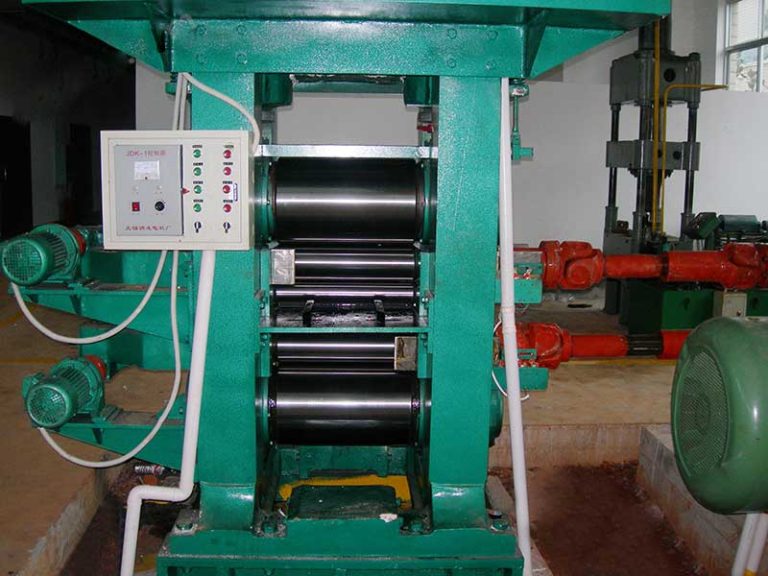
The four-high configuration remains the workhorse of the cold rolling industry. It consists of two smaller work rolls supported by two larger backup rolls. The work rolls, typically ranging from 300mm to 600mm in diameter, directly contact the strip material. The backup rolls, usually 1200mm to 1500mm in diameter, provide the necessary rigidity to prevent excessive work roll deflection under high rolling forces.
This arrangement allows for smaller work roll diameters, which reduces the contact arc length and consequently the rolling force required for a given reduction. A typical four-high reversing mill can achieve single-pass reductions of 25-40% on low-carbon steel, with total reductions reaching 80-90% over multiple passes.
Six-High HC (High Crown) Rolling Mills
Six-high mills incorporate intermediate rolls between the work rolls and backup rolls. This configuration provides superior flatness control through work roll bending and intermediate roll shifting capabilities. The HC design allows for crown adjustment during rolling, compensating for thermal camber changes and varying strip widths.
Modern six-high HC mills can process strip widths up to 2100mm with thickness ranges from 0.15mm to 6.0mm. The intermediate roll shifting range typically spans ±150mm, enabling precise edge drop control and improved strip profile across the entire width.
Twenty-High Cluster Mills
For ultra-thin gauge rolling and high-strength materials, twenty-high cluster mills provide unmatched capability. The small work roll diameter—often as little as 20-50mm—enables rolling of materials that would be impossible on conventional mills. These mills excel at producing precision strip for electronics, aerospace, and specialty applications.
Critical Process Parameters in Cold Rolling
Successful cold rolling requires precise control of numerous interrelated parameters. Understanding these variables and their interactions is essential for achieving consistent product quality and maximizing mill productivity.
Rolling Force and Reduction
Rolling force is perhaps the most fundamental parameter in the cold rolling mill process. It depends on the material’s flow stress, the geometric conditions of the roll bite, and friction between the rolls and strip. The relationship can be expressed through various mathematical models, with the Bland-Ford-Hill equation being widely used in industry:
P = w × Ld × Qp × σm × (1 + μ × Ld / hm)
Where: P = Rolling force, w = Strip width, Ld = Projected contact length, Qp = Geometric factor, σm = Mean flow stress, μ = Friction coefficient, hm = Mean strip thickness
For a typical cold rolling pass on low-carbon steel with 30% reduction, rolling forces can range from 8,000 to 25,000 kN depending on strip width and material grade. High-strength steels may require forces 40-60% higher than conventional grades for equivalent reductions.
Strip Tension Control
Front and back tensions play crucial roles in the cold rolling process. Entry tension (back tension) typically ranges from 10-30% of the material’s yield strength, while exit tension (front tension) is usually 15-40% of yield strength. These tensions serve multiple purposes:
Entry Tension Effects
- Reduces rolling force by 15-25%
- Improves strip tracking
- Prevents strip buckling
- Typical range: 50-150 MPa
Exit Tension Effects
- Controls strip flatness
- Influences surface quality
- Affects coil winding quality
- Typical range: 80-200 MPa
Rolling Speed Considerations
Modern cold rolling mills operate at remarkably high speeds, with tandem mills reaching 2000-2500 m/min for thin gauge products. However, speed selection involves careful consideration of several factors:
At higher speeds, frictional heat generation increases significantly, potentially causing thermal expansion of work rolls and affecting strip profile. The relationship between speed and temperature rise follows approximately:
Temperature Rise ≈ (Rolling Force × Speed × Friction Coefficient) / (Specific Heat × Mass Flow Rate)
For a typical pass at 1500 m/min with 20% reduction, strip temperature may increase by 40-80°C through the roll bite.
Lubrication and Cooling Systems
The lubrication system in cold rolling mills serves dual purposes: reducing friction between rolls and strip, and removing heat generated during deformation. The choice of lubricant and application method significantly impacts product quality and mill performance.
Rolling Oil Characteristics
Cold rolling oils are typically mineral oil-based emulsions with concentrations ranging from 2-8% depending on the application. Key properties include:
The emulsion stability is critical for consistent lubrication. Particle size distribution should be maintained between 3-8 micrometers for optimal film formation. Regular monitoring of oil concentration, pH (typically 6.5-8.5), and bacterial contamination ensures consistent performance.
Cooling Zone Configuration
Modern mills employ multiple cooling zones to manage thermal profiles across the strip width. A typical configuration includes:
- Entry-side spray bars: Pre-cool the strip and work rolls before the roll bite
- Bite-area lubrication: Direct application to the deformation zone
- Exit-side cooling: Rapid strip cooling to prevent oxidation
- Work roll cooling: Separate circuits for thermal crown control
Flatness and Shape Control Technologies
Achieving excellent strip flatness represents one of the greatest challenges in cold rolling. Modern mills incorporate sophisticated shape control systems that work in concert to maintain flatness within demanding specifications.
Work Roll Bending Systems
Hydraulic work roll bending provides rapid response to shape deviations. Positive bending (increasing roll gap at edges) counteracts center buckle, while negative bending addresses edge wave conditions. Typical bending force ranges from 500-2000 kN per chock, with response times under 50 milliseconds for modern servo-hydraulic systems.
Roll Shifting and CVC Technology
Continuously Variable Crown (CVC) rolls feature a specially ground S-shaped profile. By shifting these rolls axially, operators can adjust the effective roll gap profile across the strip width. The crown variation achievable through CVC shifting typically ranges from -200 to +200 micrometers, providing exceptional flexibility for different strip widths and thickness ranges.
Shape Measurement and Control Loop
Modern shape control relies on continuous measurement using shapemeters positioned after the mill stand. These devices measure strip tension distribution across the width, typically using 30-50 measurement zones. The shape signal is expressed in I-units (International units), where:
1 I-unit = 10⁻⁵ strain difference = 0.001% elongation difference
Target flatness for automotive-grade cold rolled steel is typically ±5 I-units, while precision applications may require ±3 I-units or better.
Thermal Crown Management
During rolling, work rolls develop a thermal crown due to frictional heat generation. This crown can reach 100-300 micrometers at the roll center relative to the edges, depending on rolling conditions. Management strategies include:
- Zone cooling with individually controlled spray headers
- Pre-crowned roll grinding to compensate for expected thermal expansion
- Roll change scheduling based on thermal crown development
- Predictive models that anticipate crown changes during acceleration and deceleration
Material-Specific Rolling Considerations
Carbon Steel Rolling
Low-carbon steel (0.02-0.15% C) represents the largest volume of cold rolled products. These materials typically enter the cold mill as hot-rolled and pickled coils with thickness ranging from 2.0-6.0mm. The cold rolling mill process reduces this to final gauges between 0.3-2.5mm through multiple passes or tandem mill processing.
Stainless Steel Cold Rolling
Stainless steel presents unique challenges due to its high work hardening rate and tendency for surface defects. Austenitic grades (304, 316) exhibit work hardening coefficients 2-3 times higher than carbon steel, requiring intermediate annealing between rolling passes for significant reductions.
The cold rolling mill process for stainless steel typically employs:
- Smaller work roll diameters (300-450mm) to reduce rolling forces
- Higher viscosity lubricants to prevent galling
- Cluster mill configurations for thin gauge production
- Bright annealing after final rolling for optimal surface finish
Aluminum and Aluminum Alloy Rolling
Aluminum cold rolling differs significantly from steel processing due to the material’s lower strength, higher thermal conductivity, and tendency for surface marking. Key considerations include:
The lower flow stress of aluminum (typically 80-200 MPa compared to 300-600 MPa for steel) allows higher reductions per pass—often 40-55% for soft alloys. However, the material’s softness makes it susceptible to surface damage from roll marks, debris, and handling.
Aluminum foil production represents the extreme end of cold rolling capability, with final thicknesses reaching 6 micrometers (0.006mm). This requires doubling—rolling two sheets together—for the final passes, as single-sheet rolling becomes impractical below approximately 15 micrometers.
Process Line Integration
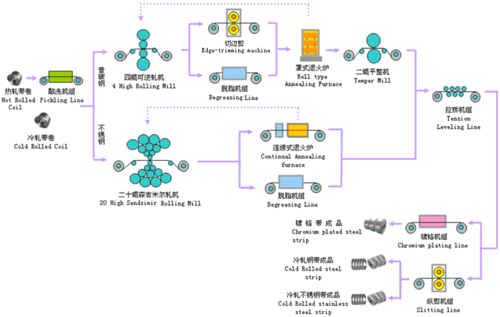
Modern cold rolling facilities integrate multiple process steps into continuous lines, maximizing efficiency and product quality. The most advanced configuration is the Pickling-Cold Rolling-Annealing-Temper Rolling (PCAT) line, which processes hot-rolled coils into finished cold-rolled products in a single pass.
Continuous Pickling and Tandem Cold Mill (PLTCM)
PLTCM lines combine acid pickling with tandem cold rolling, eliminating intermediate coiling and storage. These lines typically feature:
Endless Rolling Technology
The latest advancement in cold rolling mill process technology is endless rolling, where coils are welded together before entering the mill, eliminating the acceleration and deceleration phases associated with coil changes. Benefits include:
- Yield improvement of 1-2% through elimination of off-gauge head and tail ends
- Consistent quality throughout the coil length
- Higher average rolling speeds
- Reduced roll wear from steady-state operation
Quality Control and Inspection
Maintaining consistent quality in cold rolled products requires comprehensive inspection systems throughout the process. Modern mills employ multiple measurement technologies operating in real-time.
Thickness Measurement
X-ray or isotope-based thickness gauges provide continuous measurement with accuracy better than ±0.1% of reading. Scanning gauges traverse across the strip width, creating complete thickness profiles every few seconds. This data feeds directly into the automatic gauge control (AGC) system, which adjusts roll gap and rolling force to maintain target thickness.
Surface Inspection Systems
High-speed camera systems inspect both strip surfaces at full production speed. These systems can detect defects as small as 0.3mm × 0.3mm at speeds exceeding 1500 m/min. Defect classification algorithms identify specific defect types including:
Scratches
Scale residue
Edge cracks
Inclusions
Oil stains
Dents
Pinholes
Maintenance and Roll Management
Work roll condition directly impacts product quality and mill performance. Comprehensive roll management programs are essential for consistent operation.
Roll Grinding and Surface Preparation
Work rolls require periodic regrinding to maintain proper surface finish and profile. Grinding parameters vary by application:
Roll Texturing Technologies
For applications requiring specific surface textures—particularly automotive outer panels—rolls are textured using various methods:
- Shot Blast Texturing (SBT): Creates random texture, Ra 1.5-4.0 μm
- Electro-Discharge Texturing (EDT): Controlled crater pattern, Ra 1.0-3.5 μm
- Electron Beam Texturing (EBT): Deterministic pattern, Ra 1.0-3.0 μm
- Laser Beam Texturing (LBT): Precise pattern control, Ra 0.8-2.5 μm
Energy Efficiency and Sustainability
The cold rolling mill process is energy-intensive, with specific energy consumption typically ranging from 50-150 kWh per tonne of product. Modern facilities implement numerous strategies to improve efficiency:
Energy Saving Measures
Environmental considerations extend beyond energy consumption. Modern cold rolling facilities implement closed-loop water systems, oil mist collection, and comprehensive waste management programs. Rolling oil recycling rates exceed 95% in well-managed operations, with spent oil being regenerated or used as fuel in other processes.
Future Trends in Cold Rolling Technology
The cold rolling industry continues to evolve, driven by demands for higher quality, greater efficiency, and new material capabilities. Key development areas include:
Digitalization and Industry 4.0
Advanced process models incorporating machine learning algorithms are enabling predictive quality control and autonomous operation. These systems analyze thousands of process variables in real-time, identifying optimal operating conditions and predicting potential quality issues before they occur.
Advanced High-Strength Steel Processing
The automotive industry’s demand for lightweight, high-strength materials is pushing cold rolling capabilities to new limits. Third-generation advanced high-strength steels (AHSS) with tensile strengths exceeding 1500 MPa require specialized rolling strategies, including:
- Reduced single-pass reductions to prevent edge cracking
- Enhanced cooling systems for temperature control
- Specialized roll materials with higher wear resistance
- Advanced shape control for managing higher springback
Flexible Manufacturing
Market demands for smaller batch sizes and faster product changeovers are driving development of more flexible rolling systems. Quick roll change mechanisms, automated setup systems, and adaptive process control enable efficient production of diverse product mixes without sacrificing quality or productivity.
Conclusion
The cold rolling mill process remains fundamental to modern manufacturing, producing the precise, high-quality sheet metal products essential for countless applications. From automotive body panels to electronic components, cold rolled materials form the backbone of industrial production. As technology advances, cold rolling mills continue to evolve—becoming more efficient, more precise, and more capable of processing the advanced materials demanded by tomorrow’s applications. Understanding the principles, parameters, and practices outlined in this guide provides a solid foundation for anyone involved in cold rolling operations, whether in production, engineering, or quality assurance roles.